


In these years of silence, there are times when I do find myself in a position of collaboration with others in organizational matters, and I find myself remembering something Murshid Shamcher Bryn Beorse said: “God wanted to create Hell, so he invented the Committee” (please read with a Norwegian accent!). I suppose we all wonder what we, as individuals and as a world entity, are becoming, what is unfolding in our lives. I suppose that it is inevitable that we would, on all paths and on no path.
The question was asked, recently, what are we Sufis are doing about the Environmental crisis. For me, the question—and the possible answers—struck at the very heart of the kinds of questions I feel those of us on a spiritual path ask ourselves and feel obligated to answer. I am a member of the Sufi Order International. It is an esoteric school, it is a spiritual organization, it is an educational institution, and it carries out its work on various exoteric levels, too, primarily publishing and disseminating the teachings of Hazrat Inayat Khan and his predecessors and successors on this Sufi path. It seems to me that as individual members in this particular order, we all choose which part of these various functions we will emphasize, yet I am inclined to feel that the original—and ultimate–focus of our work is the contemplative practice, and through that mode, the dissemination of the teachings of Hazrat Inayat Khan and those who have come after him (including ourselves as we grow in this work). In other words, I see this Sufi order of mine primarily as an esoteric school.
A few years back, I heard a recording on YouTube of a talk given by a well-known Islamic scholar and social activist, speaking to a “Young Muslim Student” organization in California. He said humorously:
One of the problems that we are having is that many people want to have
a revolution. We want to have an economic revolution. We want to have
a political revolution. And we need that, but the system is broke.
It’s not working. It can’t work. But we’re trying to have that
revolution without doing the necessary heart revolution, the
transformation that is required of us individually and collectively as a
community.“You get the flip side of that too. I’ve got my lovely Sufi friends who
are the sweetest, kindest people in the whole world, and you’re like,
‘Ya know, there’s half-a-million people starving in East Africa. It’s
terrible [mutes voice into whimper]. ” I’ll go do a dhikr for them [muted
sob].” [audience laughter] Like, ‘Good, good…AND?’ [audience laughter]
‘We’re told there’s been a million Iraqis who have been wiped out. ” I’ll
go to my prayer chamber and put on some candles and incense [pause] and
do a meditation.’ ” ‘Good…AND?’ In their reflection and outer action,
these two have to be linked up together.
I’ve been kind of brooding about that since I heard him say it, first of all because it was clear from his tone of voice that he was kind of poking fun at what he calls “American Sufis,” and second because, well, I thought that “dhikr thing” he refers to WAS supposed to be important, maybe the most important thing we, as Sufis, offer to the planet, in the spirit of the rishis and contemplatives and adepts of all religions. Recently, I was looking through Inayat Khan’s teachings for something on another topic, and as often happens, I found a passage that speaks to this. He is speaking, here, of the universal sound, Hu, the sawt-e-sarmad as it is spelled in the text, and how through long practice, one becomes an instrument of that Sound that evokes the divine Reality:
The sound Hu is most sacred; the mystics of all ages called it Ismi-Azam, the name of the most High, for it is the origin and end of every sound as well as the background of each word. The word Hu is the spirit of all sounds and of all words, and is hidden under them all, as the spirit in the body. It does not belong to any language, but no language can help belonging to it.
This alone is the true name of God, a name that no people and no religion can claim as their own. This word is not only uttered by human beings, but is repeated by animals and birds. All things and beings exclaim this name of the Lord, for every activity of life expresses distinctly or indistinctly this very sound. This is the word mentioned in the Bible as existing before the light came into being: ‘In the beginning was the word, and the word was with God, and the word was God’.The mystery of Hu is revealed to the Sufi who journeys through the path of initiation. The more a Sufi listens to sawt-e-sarmad, the sound of the abstract, the more his consciousness becomes free from all the limitations of life [emphasis my own] The soul floats above the physical and mental plane without any special effort on man’s part, which shows its calm and peaceful state; a dreamy look comes into his eyes and his countenance becomes radiant; he experiences the unearthly joy and rapture of Wajad or ecstasy. When ecstasy overwhelms him he is neither conscious of the physical existence nor of the mental. This is the heavenly wine to which all Sufi poets refer, which is totally unlike the momentary intoxications of this mortal plane.
A heavenly bliss then springs in the heart of a Sufi, his mind is purified from sin, his body from all impurities, and a pathway is opened for him towards the world unseen. He begins to receive inspirations, intuitions, impressions and revelations without the least effort on his part. He is no longer dependent upon a book or a teacher, for divine wisdom – the light of his soul, the Holy Spirit – begins to shine upon him.‘I, by the light of soul, realize that the beauty of the heavens and the grandeur of the earth are the echo of Thy magic flute’. (Shefir)
It seems to me that sometimes we are in danger of forgetting why we came to the spiritual path in the first place. On the deepest level, I don’t think this is really a danger, because the contemplative path doesn’t draw people who are ultimately inclined to be distracted, but I do think that in the moment, when we are asking ourselves what we, as member of any spiritual entity, are accomplishing, whether our growth is sufficient, whether we measure up to the other “New Age” groups which category we are mostly relegated to by the world of organized religion, we may momentarily forget why we really came to these teachings that, for most of us, are so different from what we grew up with, in this culture, at least. We may form too many committees, and and in our fervent need to disseminate our spiritual understanding, may over-translate, over-disseminate, forget the role that silence plays in every word that wants to be spoken…and in so doing, create more chaos than harmony. Does the current world crisis hunger more for words and emotions, petitions and political movements, or is Hu the answer? Both, no doubt. All of these things have their place, and all of us have our paths.
Speaking only for myself, it seems important not to forget to be quietly powerful, growing like a blade of grass, as well as smashing through obstacles that appear to hinder the unfoldment of the planet, working through our minds and emotions, and always trying to look “spiritual” in the eyes of the world. It has been said that the world is upheld by the silence of rishis in caves in the Himalayas, by monks and nuns in solitary cells, by prison ashrams and everyday contemplatives, by those who remain silent and inactive in order to support and feed the world soul. Perhaps it is the development of the silent heart that leads to that Ultimate Sound that destroys and heals creation in good order.
To all those “who, whether koan or unknown, have held aloft the light of truth amidst the darkness of human ignorance.” Inayat Khan
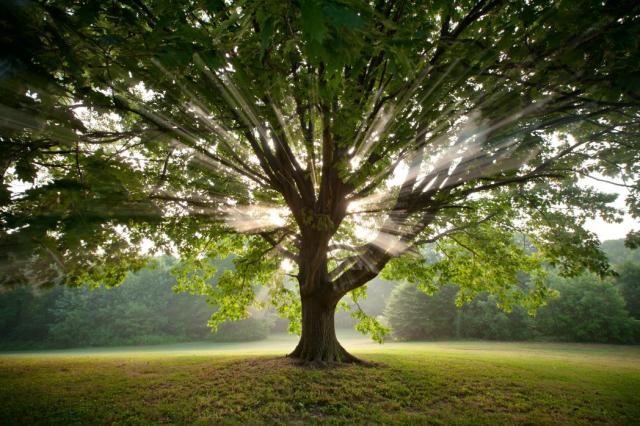
 Rays
Rays 