

Practicing

“We need to do practices with knowledge and awareness.” Amma also explained how
the Ma-Om meditation was discovered. When she was small, she used to walk on
the beach. The ebb and tide of the waves sounded like Ma and Om to Amma. Ma-Om
became like the breath, continuous and automatic. Thus, every step on the beach
was meditation.

Indicating that there is no point in changing the type of practices, Amma
pointed out how impatient we are. “People are so impatient. They jump into
sudden conclusions. A bird was sitting in a harbor and wanted to go to the other
side. It saw a ship and thinking that the ship will take it to the other side of
the harbor, flew to the mast and perched on it. The ship started on its course
and in some time was far out in the sea. As time passed, the bird got impatient
and started flying in the north hoping to reach land. After a time it got tired
and flew back. Later it tried flying south. It had to come back, it was getting
exhausted. The bird then tried east and west and seeing no land had to return
back to the ship each time. Only when the ship neared the other harbor, could
the bird see land, and shortly thereafter they reached the shore. If the bird
had been patient, it would have anyways reached the land with the ship without
flying hither and thither.

Amma concluded by explaining, “Likewise, true happiness is already within us. Be
steadfast in your practice. Practice regularly. When the awareness grows, we
will merge into that reality, that happiness within us.”

from http://www.amritapuri.org/8287/mantra-maom.aum

Recently, I was talking with a friend who, like me, has practiced meditation for many years.  We agreed that there is a point at which one begins to feel rather as if one has “gotten it,” and feels less of an imperative to practice “religiously,” keeping to a rigorous schedule and lengthy practices.  It is also true that, over time, we tend to find, more and more, the “guru within,” and we become gradually competent to fly “solo.”  In other words, we become our own teachers, and we feel–just a little–as if we are starting to know what we’re doing.  Let me hasten to add, here, that if the above isn’t really true, if one is being beguiled by the ego and not anywhere near this point, these feelings can be a trap.  This is but one of many reasons I continue to believe it is necessary to have an earthly teacher or guide, someone to hold up the mirror of truth that the sincere seeker needs to consult regularly.  And it can be a trap anyway, as my friend pointed out.  He said that if left to his own devices, he does indeed continue to practice, but that he gradually lets other things get in the way, and eventually finds himself getting in a good meditation session maybe twice a week.  He pointed out that it’s like living on interest, rather than increasing one’s capital.  Something like that.  I think he is quite right, and have found this for myself, because rebel that I am, I actually took a “sabbatical” of some ten years, from my spiritual community and my roles as both student and guide.  In theory, I didn’t include practice in my “sabbatical,” but I did indeed begin to slack off, and eventually found myself in pretty bad shape, because life will teach us when we don’t avail ourselves of an easier, gentler way, which to me is contemplative practice.  As Matthew 11 in the Holy Bible says,

Come unto me, all ye that labour and are heavy laden, and I will give you rest.

Take my yoke upon you, and learn of me; for I am meek and lowly in heart: and ye shall find rest unto your souls.

For my yoke is easy, and my burden is light.

My old friend Himayat Inayati used to say that Jesus meant that his “burden” is, literally, LIGHT.  Yes, indeed.  But I have had problems with faith throughout my life, which is common to children of hurt parents, and I tried to go it alone.  I was fortunate in that I had already been taken pretty far up the ladder, but there was still that hurt inner child that was afraid of the surrender necessary to go all the way.  And I suffered for it.  My life’s teacher, Pir Vilayat Inayat Khan, said that there is a fundamental choice that must be made by people like me:  I can either be pushed by the past or pulled by the future.  Ah, but how to get away from that eternal SHOVE and live into the lovely, thrilling, gentle tug that takes us on into the eternal?  It wasn’t easy for me, even though I already did have some capital in the bank.

Becoming very ill and disabled was a result, for me, of that ongoing push from the past, and it pushed me right up against….me.  There was nowhere else to go.

For several months now, I have been studying the teachings of Inayat Khan weekly with a good friend, via Skype, and that has been a new beginning for me.  It is really the Sufi practice of losing the false self first in the teacher, then in the Master, and eventually in God.  Through these progressive attunements, one makes oneself open to the teaching and then, to the very being of the One it all comes from.  A Light burden indeed!  And doing this led me to a re-commitment to practice, and I began giving myself over to practice at least twice a day, going right back to the beginning when it was like doing calisthenics for the beginner:  at first, you have to do them “just right,” and if you eventually trip up by not doing so, you have to go back and pick up where you left off.

It worked.  The Sufis have a profound psychological and spiritual practice as outlined in the 99  Beautiful Names of God, in the Dhikr that is the remembrance of the way God (we) really is/are.  There are various other practices with breath and light and sound, but these are the two central practices, and they work.

No, I have not levitated–yet.

Yet there are glimmers, in my own personal process of alchemy, that as I gradually give up my attachment to my temporal self, the one that jumpa up and down and clamors for this and that and feels oh, so hurt over this, and Grrrr!  So Angry!!! over that, that this push from behind that I spoke of lessens, and I can slide gently onward into the pull that awaits.

The spiritual path is easiest if there is not something pulling one from behind; and that force is the life in the world, one’s friends, surroundings, acquaintances, and one’s foes. Remain, therefore, in the world as a traveler making a station on his way. Do all the good you can to serve and succor humanity, but escape attachment. By this in no way will you prove to be loveless. On the contrary, it is attachment which divides love, and love raised above attachment is like a rain from above nourishing all the plants upon the earth.  ~~Inayat Khan

I sustained a great blow recently.  I realized that I had to end my relationship with someone I love very much (and her child, therefore), but who has problems with living and had long been in the habit of targeting me with her pain and sorrow over herself.  In a mistaken belief that I was somehow responsible for allowing this kind of treatment from this person, I had allowed myself to become so debilitated by her rage and misery that I was becoming more and more ill.  I had tried, for many years, to realize this–had known it all along:  that I was not helping her, nor was I helping myself in allowing myself to be scapegoated in this way, and I resolved–for about the 100th time–to end the relationship, at least in terms of our physical association.  It seems to me that there are times when this is necessary in the closest of relationships, for both parties, but it was extremely painful for me.  I thought I would die from the pain, in fact.

Pir Vilayat once said to a group of his students that if we really knew what love is–truly is–we would be annihilated in our understanding.  I think life offers us the opportunity to learn about love, even to these heights, if we desire to.  As my Murshid says above, “love raised above attachment is like a rain from above nourishing all the plants upon the earth.”  It seems that there are times when to love in this way means giving up one’s personal needs for affiliation, for closeness, for friendship…and the result is that at least one more roadblock in the path of love is removed.

So:  practice.  Practice deeply, ceaselessly, with devotion and without ambition.  It doesn’t matter what the practice is, what matters is to develop the soul-power, to grow the soul along with the body and the mind.  The rest follows.

Balancing Acts

Keep fast and eat also, stay awake at night and sleep also, for verily there is a duty on you to your body, not to labour overmuch, so that ye may not get ill and destroy yourselfs; and verily there is a duty on you to your eyes, ye must sometimes sleep and give them rest; and verily there is a duty on you to your life partner, and to your visitors and guests that come to see you; ye must talk to them; and nobody hath kept fast who fasted always; the fast of three days in every month is equal to constant fasting:  then keep three days’ fast in every month. –from The Sayings of Muhammad, by Allama Sir Abdullah Al-Manum Al-Suhrawardy

So I am healing after the terrible ordeal the world and I imposed upon myself, the one that finally caused me to have both knees replaced and nearly killed me.  It was the first foray I had made into the halls of allopathic medicine for quite some time, having concluded long ago that too many of the doctors of today are more invested in making money in keeping their patients sick than in true healing.  But sometimes, perhaps, one must elect to be “healed with steel,” as in my former posts about all this;  and so I tried that, and it was a terrible way to convince myself that I was right in the first place.  And now I work to heal the damage and make use of these new joints which gradually come to seem more and more a part of me.  What other choice is there?

These days, my healing process is a nutritional one, through the very important work of Joel Fuhrman, M.D., who strives to take us back to the diets of the Yogis and those other ancients who taught the original lessons we have in healing through the mind-body connection.  The above quote from the Prophet Muhammad (peace be upon Him) shows that those who teach the path of the soul have always shown that honoring the physical self through right attitude and right nutrition and, very importantly, balance, is the way to keep the soul fit and supported by the body on its journey.

It is this idea of balance that concerns me at the moment, because I have been through quite an ordeal, and there must of necessity be times when a pretty extreme balancing act in the cause of restoring health and wellness is warranted.  At the moment, I follow a pretty restrictive nutritional regime which includes occasional fasting, and otherwise includes a great many dark green, leafy vegetables, beans, few grains and a lot of fruit.  I have a daily exercise routine, and there is theoretically not much room for socialization and celebration in the sense that the rest of the world terms such.  I just had a birthday, and of course there is a certain obligation to celebrate on those sorts of occasions, at least so the rest of the family can eat cake, but my daughter lovingly made me a wonderful chocolate cake made with tofu, bean flour and flaxseeds, and the only problem was not eating too much of it (perhaps I should post the recipe here).  So I got through that one.  But balance is the name of the game on this planet, at least, where we come to learn how to be human, which is to say, fully Whole, fully God(dess).  We seem to be a culture of perpetually guilty people.  We strive to “do it right” and beat ourselves up when we think we haven’t.  We attach ourselves to various gurus who will supposedly take responsibility for us, making sure we are on the right path, and if they are authentic gurus, they generally do advocate balance in living and loving kindness toward the self and others.  Yet we continue to be exacting and unkind to ourselves.  What is behind that?  And why is it that we cannot seem to trust ourselves to do the right thing, and must have someone else to take that responsibility from us?  I refer to the aforesaid gurus here.

The true meaning of faith is self-confidence.  –Inayat Khan

As far as I can tell, it begins in infancy.  Food is the center of our lives of necessity, and as the providers of food and other nourishments necessary to the soul on earth, it is the parents who become the first gurus.  If they fail us, and if we believe in the theories of Freud and others, it is in those years that we learn the lessons that will dog us our entire lives.  The very act of breastfeeding, if a chid is fortunate enough to be nursed, is rooted in the emotions, the heart-feelings of love and nurture.  Sexuality comes into it, simply because it is the same hormones that let down the milk that bring about orgasm.  These are inevitably tied to the development of trust.  Thus, it is in these very earliest years that we make our decisions about how we will live, and whether we can trust the world.  If those first gurus fail us, then we may conclude we can only trust ourselves, or we spend the rest of our lives trying to find someone to trust.  If our parent-gurus don’t fail us, if they are there for us and encourage us to develop autonomy out of the womb of their containment, then we are fortunate enough to grow up trusting ourselves.

At least that’s the way it would seem to be historically.  In this day and age  we are, however, victimized by an increasing barrage of contrary messages to the ones we learned from our first nurturers, and we are encouraged over and over not to trust ourselves.  Depending on our innate resiliency, we either survive and flourish despite all the false gurus, or we fall under the weight of the huge corporations, the pharmaceutical companies, the fast-food restaurants and food and alcohol commercials and ads, all of which promise us that if we will just use their product, we will not only be well, we will find the meaning of life and achieve perfect happiness.  How many of us can turn a deaf ear to the promise of instant gratification and an easy “fix?”

Recently, I have been privy to a discussion about the proliferation of Buddhism in this culture.  The Dharma, I hear, has moved to the West.  While my own world-view holds that there is truth in all religions, I can see why the Middle Path is a lifeline to those of us who are trying to swim our way to the far shore through the wreckages of junk food,  junk living and junk emotions we have had forced upon us.  In fact, as illustrated by the quote I started this entry with, moderation, self-trust and loving-kindness are among the teachings of all the authentic teachers of humankind.

Stop.

Hold Still.

Breathe in and out.

Let go.

______________________________________________________________


Better to stop short than fill to the brim.
Oversharpen the blade, and the edge will soon blunt.
Amass a store of gold and jade, and no one can protect it.
Claim wealth and titles, and disaster will follow.
Retire when the work is done.
This is the way of heaven.   –Tao te Ching, trans. Feng and English

Ah, letting go…  It’s been called renunciation, relaxation, even crucifixion:  somewhere along the line, if we want to come Home, we have to let go of the untruths and, from the vantage point of a clear playing field, examine What Is.  Somehow, somewhere, the voices have to stop clamoring, the frenetic visions have to be tuned out, and we have to come home to ourselves prior to the stories all these tell, all the stories told from the very beginning.  Is it possible to live without story, without the myths that shape our days and nights?  What if we become able to look at our actions and our practices in a clear light that is not surrounded by Concepts.  Then what will we do?

I would say that renouncing the myths I live by (also known as “Killing the Buddha”) is just about the hardest thing I have done or ever will do, because I expect it to be a lifelong project.  It requires being constantly present to the moment and to myself.  It requires examination of my motives and actions, first to ask myself what myths I’m playing out in them, and second, by deciding what is Right Thought and Right Action when the stories have been cleared away.  It requires loving-kindness toward the world and toward myself, and it requires self-confidence.  It was lack of self-confidence that made me sick, and it is Wise Pride, as Inayat Khan terms it, that will make me well.

Grandmothering

The heart which is not struck by the sweet smiles of an infant is still asleep.  –Inayat Khan


There must be a lot of new grandmothers out there, because when I first wrote a post called “Becoming a Grandmother,” it quickly became the most popular post I’ve written here.  It makes sense, because other than pretty little photo albums and “grandmother’s brag books,” I don’t suppose there are many people out there exploring what it means to be a grandma.  Yet, it really is a whole new category of mothering, spiritually speaking.

The little darling whose picture is here as an infant is now nearly three years old, and I find my relationship with her to become deeper and yet lighter every day.  I worry about her almost as much as I did my own daughters, I find, yet the “Mommy dynamics,” so omnipresent in the mother-daughter relationship, seem to be missing.  She’s a toddler, of course, and as much a pain in the ass as other toddlers, yet I have a sense of friendship with her, which I imagine is different than the feelings her mother has; she must worry and fret and discipline and clean up vomit and pick up toys and do all the things mothers do ad nauseum.  I remember all that with her and her sister, and I remember that some days it was hard to find the sense of wonder that Grandma can access rather easily these days.

Such a little person!  I often wonder whence the soul comes who comes to earth with the unique purpose that all of us do.  In the case of this one, she already shows evidence of being a healer:  a few weeks ago, she discovered my knees.  If you have waded through all my posts here, you know that I had both knees replaced in the last year, and suffered from repeated infections that necessitated repeated surgeries and even the removal of one knee for some weeks.  When Lily saw my rather horrible-looking healing knees, she was shocked.  She quickly collected several pieces of equipment to assist her, and she set about healing my knees:  she shined a flashlight on them, she made “drilling” sounds with something else, and all in all, seemed to be intent on making Grandma’s knees better.  My daughter tells me that at the playground last week, Lily met a little boy who had some mnor health problem, and became very concerned.  She offered to kiss his wound, and told him he must go to the doctor.  Little episodes such as these are occurring with increasing frequency.

My daughter has some problems with living, as most of us do;  and she told me that one morning, Lily took her face in her little hands and asked her, very concernedly, “Mom, are you happy?”  When she was answered, “Yes, I am happy,” the baby cheered, very excited for Mom.  Toddlehood is the age of healthy narcissism, and it seems rather extraordinary to me that this little girl is so capable of being concerned for others.

Who knows where such behaviors come from?  Whatever one’s conception of the soul’s journey to and from incarnation, we are all different, and seem to arrive with different talents and gifts and, sometimes, deficits.  It is so easy for us, as parents, to both congratulate and blame ourselves for what our children become, yet my impression is that they bring most of who they are with them.  That lets us, as parents, off the hook, but it also means we have the responsibility to see our children as unique human beings, not carbon copies of ourselves.

It is such a blessing to be part of this little soul’s blossoming.  It is a privilege that we, as her family, are her tribe, the ones who have her back.  She is her very own miracle, and we love sharing the unfoldment of that with her.

How to Fly

The Eagle wasn’t always the Eagle. The Eagle, before he became the Eagle, was Yucatangee, the Talker. Yucatangee talked and talked. It talked so much it heard only itself. Not the river, not the wind, not even the Wolf. The Raven came and said “The Wolf is hungry. If you stop talking, you’ll hear him. The wind too. And when you hear the wind, you’ll fly.” So he stopped talking. And became its nature, the Eagle. The Eagle soared, and its flight said all it needed to say. –Marilyn inNorthern Exposure, Season 5

I blush to admit it, but Northern Exposure was actually one of the main reasons we went to live in Alaska.  My husband and I have been watching the old episodes recently, and we laugh at how Lower Forty-Eighters were fooled into thinking the series actually had anything to do with Alaska:  it was filmed in Washington, had few Native Alaskans in its cast, and generally was a fraud perpetrated on an ethnocentric nation.  Loosely based on one of our favorite villages, Talkeetna, it told a tale about a village that moved all over the state, depending on what each week’s plot demanded.  And yet, there was something about the eccentricity of its characters that did indeed evoke the peculiarity of living in the real Alaska.  But back to the Eagle:

I have a problem with people who talk so much that I don’t get to talk when I’m with them.  I’m sure that part of my problem arises from being a therapist:  I generally feel obligated to do most of the listening, and I’m inclined to step aside and let the other guy have the field in conversation…and afterwards, to feel resentful, if I don’t happen to be in a magnanimous mood that day.  I wish I were more saintly about this sort of thing, but I’m just not.  Yet.

It is odd how many people seem to need to carry the conversation, seemingly not noticing that they are the one’s who are doing most of the talking and very little listening.  Or perhaps, for some reason, I just tend to have friends like that (is it possible other people don’t?).  The odd thing about this, I notice, is that some of the most reputedly erudite figures in my life have been the most garrulous.  It is strange to me that, at some point, these people don’t notice that they have learned nothing, in conversation, that they didn’t already know.  One could draw the conclusion that they most enjoy hearing themselves, and not the other, talk.  Take our friend the eagle, above:

Yucatangee talked and talked.  It heard only itself. Surrounded by the wonders of nature and other creatures, Yucatangee was only interested in hearing itself.  What motivates this need?  Not the river, not the wind, not even the Wolf. Not even the wolf!  To put oneself in that kind of danger in the interest of holding forth to that degree is either a brave or foolhardy thing!

And then our friend the Raven, the Trickster, came along:  “The Wolf is hungry.  If you stop talking, you’ll hear him. The wind too. And when you hear the wind, you’ll fly.” It seems to me that it would take quite a bit of courage to stop talking long enough to hear the wolf:  is it possible that Yucatangee thought his words would keep the wolf at bay?  Yet eventually, it became brave enough to take a chance, and when it did, it heard the wind, and it was able to fly.  So he stopped talking. And became its nature, the Eagle. The Eagle soared, and its flight said all it needed to say.

Words, words, words….they weigh us down, they build a wall, they keep us separate.  When the words stop, our flight says what we wanted to say all along anyway.

Hermitage

As for people, it seems that even the birds and beasts have times when they concentrate. They meditate, in their own way, and they offer their prayer to God. There is no being on earth, however small, who does not contemplate for a moment. If one’s sight were keen, one would also see, by sitting in the solitary woods or by sitting in caves in the mountains, that they all have their prayer and their at-one-ment with God. Why do the great ones, the souls who do not find rest and peace in the midst of the world, go to the wilderness? It is in order to breathe the breath of peace and calm that comes to them in the heart of the wilderness.  –Inayat Khan

No one attains peace by fighting.  — Inayat Khan

Possibly the greatest gift that has come to me in this past year of pain and boredom is peace.  I need a great deal of it.  I revel in it, I absorb it, I try to radiate it:  it is more necessary to me than the food I eat or the air I breathe.  C.G. Jung wrote extensively about his own perception of  psychological types, differentiating people between introverted and extroverted, first, and then into variations of these.  From those early writings, all sorts of systems of classification have arisen, culminating in the famed Myers-Briggs test that theoretically enables one to decide which category one falls into, and then compare themselves with famous people who also fall into that category.  As to whether such scales are accurate probably lies in whether they are useful to the individual, and I’m not particularly interested in them, although I do find it interesting that I appear to fall into the same categories as Jung himself:  I am an introvert who is good at appearing to be extroverted; I am intuitive, and I am feeling; I can be extremely mental, and certainly analytical, yet base my final conclusions on my perceptions, which come to me intuitively.  It is the first of these that I find the most interesting:  that when in a crowd, I seem to do just fine at holding my own; I am a teacher by nature, and I am a person with a mission in life.  Interestingly, however, all this must live side-by-side with what I consider to be the “real” me, who is quiet and rather shy, needs a great deal of “down” time, is a fantasizer and a visionary, and a natural contemplative.  I have often said that if life did not present me with a marriage and family, I would be in a monastery somewhere, living a deeply satisfying inner life.  A friend told me that I am a “sensitive,” one of those who lives an inner life and contributes to the world from that standpoint, rather than wading into the fray and fighting their way through life.  I haven’t always allowed myself to be who I am:  like most Americans, my belief tends to be that I ought to be out there, slugging away and doing, doing, doing.  Having come to the culmination of some clearly stress-related physical problems, I now question this belief, and am working to find a way to be both sides of myself.

It is interesting to observe people and watch how they accomplish their ends in life.  I have someone in my family who says he believes in fighting about everything, and if the other person refuses to fight with him, he does not respect them.  That is an interesting (and to me, exhausting) example of the extroverted type, eh?  I suppose he would be termed a warrior type.  In a sense, of course, we must all be warriors, although some of us fight the battle within, rather than trying to gain our ends through warring with others.

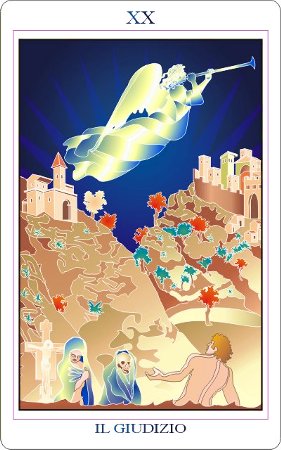
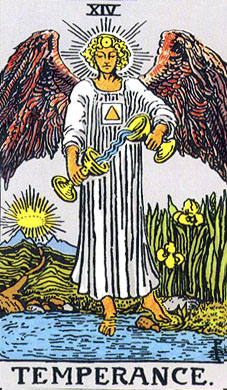
The Tarot provides one of the best systems of illustration of psychological types I’ve ever seen, and I’m sure Dr. Jung must have agreed, for here, in this deck which has survived for centuries, popping up in various cultures and times, we have, in the Major Arcana, beautiful descriptions and representations of some 22 types of humans:  for the extroverts, we have the Emperor and Empress, for the Introverts, the High Priestess, the Hierophant, the Hermit. . .   And then there are all the variations of personalities that arises from these:  the Fool, the Hanged Man, the Judge, etc.  There is another way to look at these that makes sense in a broader fashion, as well:

As I understand it, the soul manifests out of the Divine Unity, God undifferentiated, and on its way toward incarnation, it passes through all the realms of being, from the realm of Splendor, through the various angelic realms, then to the Jinn and Astral planes, and finally, before the culmination of its journey, literally through the realms of animal, vegetable and mineral existence.  Thus, the soul comes to earth, its ultimate test, with all these influences, more or less impressed with each according to the interests and attunements it develops on its journey.  Accordingly, it makes its return journey with the influences it is impressed by here on earth.  Jung said that the archetypes, these illuminations of the impressions we gather in the creation of personality, are actually eternal and unchanging, even though our perceptions of them change, thus rendering them dynamic as well as fixed in eternity.  Thus, I am thinking of how these types I mentioned above apply to our identifications with these archetypes, and how our consideration of them may be useful to us at the various crossroads that we come to.  They are useful in contemplative practice, as well.  For instance, I suppose my identification has been with the Hermit increasingly, in the past year, and now I feel as if I am coming into the Fool, stepping off my self-created precipice into sheer, empty space, my eyes fixed on my ideal, my arms outspread and my heart wide open.  The Fool represents the original being of God emerging into human form, prior to cause and effect, to karma or memories, no past, only openness stretching ahead.  The Fool is a being of faith, first and foremost, because he knows no other than the Friend, peace, that presence that is always within, at hand, the ethereal air we breath and the dirt beneath our feet on the road of life.

As I was writing all this, my dogs made it known to me that they wished to go out, and it wasn’t their “time,” but I got up and let them out and was drawn out to sit on my deck, where the Friend pulled me quickly into that embrace wherein all is the song of the birds, the sound within sound, the peace within peace.  I am grateful.

May these vows and this marriage be blessed.
May it be sweet milk,
this marriage, like wine and halvah.
May this marriage offer fruit and shade
like the date palm.
May this marriage be full of laughter,
our every day a day in paradise.
May this marriage be a sign of compassion,
a seal of happiness here and hereafter.
May this marriage have a fair face and a good name,
an omen as welcomes the moon in a clear blue sky.
I am out of words to describe
how spirit mingles in this marriage.
Rumi, Kulliyat-i-Shams 2667

Indifference and Detachment

Indifference and independence are the two wings which enable the soul to fly.  —  Inayat Khan

Indifference and independence are two words that those of us imprinted by the Judeo-Christina culture  put a spin on that causes them to sound rather uncaring or, in the case of independence, unconnected.  I think women, in particular, live their lives in ‘connection mode,’ the perspective that everything originates and culminates in relationship, and I think that is true, although not in the way it might seem, at first, to be. But one at a time:

I told, in an earlier entry here, about a dream I had (one of those dreams that is not a dream) about my Murshid, Pir-o-Murshid Inayat Khan, who came to me and explained the true meaning of indifference to me:  indifference, he said, can only come from being completely and utterly in love.  This was a revelation to me, as I would have thought that indifference meant not caring.  But it’s true:  if one loves utterly, then one is indifferent to the other, because no matter what happens, no matter what the other person does, one sees only love.  My younger daughter demonstrated this to me recently, when in one of those “do I look ugly in this dress” trips women put themselves through, I said to her “I know why your father thinks I’m wonderful no matter how I look, but you say the same, and I’m sure you must notice my imperfections…”  And she just shrugged and said, “You’re just my mother, and I love you.”  And there we have it:  those who truly love us see only love.  This is why, I learned in a psychology class, children forget what their parents look like very quickly if they happen to die:  they didn’t see what the world saw, they saw only the face of love.  Perhaps our children teach us our first and last lessons in love, because one learns, as a parent, that there is no love so glorious, so horrible, powerful, and obsessive as the love one has for one’s child.  When our children are young, we are imprisoned in a love and protectiveness that are powerfully intense.   Yet if we use those feelings to learn to  love well, that love become transmuted into the deepest love that could exist on this earth, and complete indifference to what the child does, because whatever they do must be what they need to do.  I have been discussing recently, with some friends, the generation of parents that came before us, the one that learned “spare the rod and spoil the child” from their parents, and believed that giving their children whole approval and whole love would somehow “spoil” them.  With my children, I have found it to be completely the opposite, and although it was hard to grow up with such unforgiving and sometimes cruel parents, I feel more sorry for them that they missed the joy of true love with their children.

So, indifference:  to be able to love so completely as to be uncaring, detached from the actions of the object of one’s love.  Wherever it starts, whatever or whoever one loves completely, it seems that the next step would be to spread this love out to encompass all one’s relationships and finally, the world.  How could we have a problem with anyone if we love this much?  It sounds a bit daunting, though, to learn to love so much, because that degree of love might be seen as annihilating in its totality:  if I love that much, will there be anything left of me?  That is the pivotal stop on the road to true love.

In order to arrive at spiritual attainment two gulfs must be crossed: the sea of attachment and the ocean of detachment.  –Inayat Khan

I remember when I was young, spiritual attainment meant developing the ability to reach “high” states of consciousness, to be someone with an atmosphere that said to people “this is a holy woman.”  It didn’t take long, however, to learn that on this plane of existence, attainment means falling on love so completely that there is nothing but the beloved.  When I was that young, I saw the beloved in my children, my friends, my husband, my teacher….yet I learned, finally, that to do justice to that love so terrible in its intensity and its promise, I had to learn to love the whole world that reflected itself in my beloveds.  I thought that indifference and detachment meant a withdrawal from the world, and learned that it meant the complete opposite.

...Nothing ever goes away until it has taught us what we need to know. –Pema Chodron

Indifference and detachment are the end of love-longing  They are the mountain paths we follow to get there.

The Foundation of My Life

I really don’t have the slightest idea how most of this “blog” stuff works, and it is only when dire necessity forces me to that I try to learn some new “trick” to get across what I want to say.  Compared to the other blogs I see, I’m not very far along, but my trade is in words and images, and so far I’m doing fairly well with those.  Recently, when looking at my stats, I followed a link to see what it was that caused someone to come to my blog, and I found a nice blog on the Tarot, which is one of my fascinations and one of my best learning tools.  The person who authors that particular blog had explained his link to my blog (which I hadn’t even known about, but hey…) as “one of the best Sufi blogs I know.”  I thought that was quite an honor, as at this point in my life,  I am a fairly invisible Sufi, as Sufis go.  I remember when I first heard of Sufism.  I was a junior in high school, in rural West Virginia, and I had a student teacher who was interested in Sufism.  At that time and in that locale, this was an incredibly arcane topic, but I searched and found a reference or two in the dusty books at the back of the local library.  Somewhere during that period, I read Khalil Gibran for the first time, and I knew he was someone who was pointing out my way to me, but at that time, I didn’t know that he was known as a Sufi.  Then, lo and behold!  I saw that a network news program was going to have an interview with “A Sufi Mystic.”  It turned out that the mystic was my own lifetime teacher, Pir Vilayat Inayat Khan.  I was 16, and I didn’t know the first thing about mysticism,  I had no idea what meditation was, and I didn’t know what it meant to have a spiritual teacher.  Except….  I did.  I looked at this strange-looking gray-haired man in what looked like a wool robe and mantel, and I thought to myself, “I belong to that man.”  And I did, even though I didn’t really know what that meant.  In my senior year, I wrote a research paper on Sufism, and I would imagine that it was quite a piece of work, although when I came across it years later, I didn’t think it was too bad.  God knows where it is now.  But God always knows.

A few years later, age nineteen, I went to a group that studied the teachings of Edgar Cayce, and I told the other members that I was a Sufi.  I told them I wanted to find a group that studied Sufism, and they directed me to the local Theosophical Society.  I was, at that time attending art school in Cleveland, Ohio.  That era was really the beginnings of my spiritual search:  I attended many spiritual groups and meetings;  I joined the Ananda Marga Yoga Society, and took initiation in that path, carefully explaining to the initiator that I was really a Sufi; he didn’t seem to mind.  I attended many of the local Self-Realization Fellowship’s meditation groups, and I learned Sufi Dancing through another group of Yogis.  In time, I became quite an organizer for local spiritual happenings, doing publicity for Baba Ram Dass when he came to town.  We organizers were given the honor of having dinner with Ram Dass, and I remember it as being a very tense, formal occasion.  I don’t know whether he was more tense, or we were, but we were all quite self-conscious.  I think that our old friend Ram Dass would laugh with me now, remembering that.  In fact, he probably is right now.   It’s funny, you know….  We all, all of us in those halcyon days of the “Spiritual Trip” that was happening at the same time that people were “turning on, tuning in and dropping out”….we all seem like old friends now, all these years later, members of the same family.  Ah, those were the days…Sufi Dancing on the grounds of the city art museum, doing kirtan, dancing with the local Hari Krishnas,  sitting, sitting, sitting, here, there, everywhere, trying very hard to get “high,” and sometimes actually achieving it.  Eventually, I found an initiator among the local Sufis (she deserves her own entry, to be accomplished soon), and then Pir Vilayat himself came to town, and the rest is history.  He is my teacher, and now that he is no longer in the body he carried around when I knew him, he is more present than ever in my life.  He was a tirelessly responsible spiritual father to me and his students:  he inspired us all to join him at meditation camps in various beautiful places, and what he taught me–often sternly, always lovingly–became the foundation of my life.  I was an active representative for his work for many years, and then…well, I became silent, and more silent.  I began to stay still, and that stillness grew.  I began to feel that I hadn’t done very well at being somebody, so perhaps I’d better try to be Nobody.  As all that was happening, however, I was going back to school to study psychology, and I found, in academic study, that what I’d already been given by my teacher was far more advanced, far more elegant and far-reaching than the narrow disciplines and philosophies I was being taught.  Yet it all melded together, and one inspired the other.

It’s late, and I’m not entirely sure where I’m going with this entry.  I think I just wanted to comment on how very much my spiritual path has meant to me, and why.  The why is the easiest part, really:  I was taught to walk a path of spiritual freedom.  I was guided away from a dreary path of narrowness and onto the broader highway of truth.  And all I was taught came to me in the guise of beauty, of light, of harmony.  I learned that I didn’t have the slightest idea what love really was, but I had a sense it was somewhere near, and there have been moments…  And I learned to look.

A few weeks ago, I attended a workshop on sacred chant, and at one point in the seminar, the leader played her guitar and suggested that we all get up and greet each other in whatever way we chose.  It was a very beautiful moment, and after nearly a year of solitude and inactivity, I felt the wonder of soul greeting soul, of bowing to another and feeling my crown chakra igniting theirs, of looking into the eyes of God with the eyes of God…

And all that, he taught me.  I am no one, going nowhere, I know nothing, yet with his help, I may someday Know.

Sometimes the depth of a teaching, not seen at once, is understood later. I sang a mantram fifteen years without understanding it, and then suddenly it was revealed within me. There is a teacher in every one of us, who teaches when the time comes.  –Inayat Khan

Hanging in

http://www.llewellyn.com/tarot_reading.php

Recently, a friend mentioned that he’d been checking frequently here to find out how I was since I last posted, because he was concerned about my condition and thought that if I had stopped addressing my fans (both of you!), things must be really rough.  It occurred to me, then, that it really had been a long time since I’d written anything, and somehow this seems significant, as nearly everything does these days… and so here I am.

Well, it has been rough, and although the worst is over (I hope), the climb back up is taking quite a long time and is fairly hard.  Not knowing exactly what I’m climbing back up to is also rough, but rather interesting.  As to the details of this particular adventure, I had mentioned in my last post that, having had successful surgery to replace one knee, I had the other one replaced, only to incur an infection that kept returning and kept taking me back to the operating room, the last time to remove the “new” knee and replace it with an antibiotic “spacer” which would allow for healing, so that the knee could be replaced again.  This meant that I had to spent approximately two months in bed, as I was not supposed to bend my leg or put any weight on it, and I have never had an experience quite like that before.  It was quite painful to accomplish the little movement I was allowed (trips to the bathroom and such), and even more painful was the boredom of immobility.  I spent the time writing, reading, working on my computer, communicating with friends and doing my best to make the time count for something.  In the end, I think it did count for something, but not exactly what I’d first thought, and I am still sorting it out.  In mid-December, the new knee was put in, and hopefully that will be my last surgery.   Now I get to assess it all, while I try to put back together a life that was put on hold nearly a year ago, although at the time I told myself it would be six months at the most.  These experiences are accompanied by some trauma, as might be expected, although I am one of those people who tends to just grit my teeth and tell myself I’ll be fine while the process is taking place, and it is only afterward that I realize I am left with numerous unresolved feelings about the whole thing.  These come under several categories:  first, there is the mainstream medical profession, and the “helpers” that accompany its work.  I have been inclined, as an adult, to steer clear of allopathic doctors, and this major surgery was my first brush with them since my first child was born some 30 years ago.  I do not recommend it, overall, although if one truly needs them it’s good that they are there.  And surgery seems a more appropriate recourse–if necessary–than much of what counts for healing these days.  I needed to have surgery, and I’m glad I did it, but I wish all my holistic and alternative measures had prevented it.  Still, having done all I could on my own, it’s good that I was able to feel that I had no other choice.  Before it was over, I went through three doctors before finding one that I felt actually cared about me as a person and truly wanted to heal me rather than just collect my medicare dollars, and it was instructive to find the courage to take care of myself by doing so.  It paid off, finally, but I wish I’d found that courage earlier.  Then there were the “helpers,” the “little people,” the “mid-level professionals” who took care of the details the doctors left to them, and I learned much about healing and human nature from them.  Some of them became real friends, some of them just didn’t care, and some of them seemed to need my help more than I needed theirs, which is always interesting.  While in the hospital, I noticed myself doing more therapy than was done for me, and I was glad if I could help, but I did wonder about it.

Second, there was the effect of all this on the instrument of my embodiment–my body–and that is both interesting and depleting.  In one of my favorite books, Women Who Run with the Wolves, Pinkola-Estes speaks of the body as the sensor and recorder of all our experience.  My body went through quite an invasion, and it held up admirably, but I am tired, and I often wonder if I’ll ever get back my former energy.  On the other hand, such an experience leaves one realizing that one only gets so many chances on this plane, and I’d better get the lead out–literally and figuratively–if I want to wind things up in any organized and complete fashion before this phase is over.  So I tell myself that this is an admirable priority to hold just now, and I do my exercises faithfully and wait for the return of chi, libido, energy, moxie, all of the above.

Going deeper:  I have the strange sense that this entire experience somehow marks a transition in my modus operandi, which to this point has been largely characterized by shoulds. I should do this, I should do that, I should do it this way, it is my responsibility to do a,b, and c.  Such attitudes are characteristic of adults who grew up in chaotic homes of one kind and another, people who had to do their own parenting, and thus became perfectionists in the attempt to merely keep themselves alive as children.  I notice that this time of life seems to mark a change from that sort of attitude and one that says “how do I want to do it from now on?”  After all, I am a white-haired old lady now, and it seems that this is my time to begin to kick up my heels and thumb my nose at all the nay-sayers who want me to affirm their own positions about life, the universe and…whatever.  And why not?  I tried doing it “their” way, and that only got me so far.

I find that I have begun a process of reflective living, a kind of contemplative style of being that has few shoulds other than the internal ones, one that is actually the one I would have chosen in the first place had I felt I had the choice.  It seems to me that there is a need to find a way to live this, so that my direction in the future will be clearer.  One thing that I am able to acknowledge for myself now is my need for quiet, for loneliness, for silence.  It seems absolutely necessary that I allow myself these in the course of my day.  For someone who has followed  a contemplative path, this ought to be self-evident, but perhaps there are levels, or rings as one goes down into the silence and spins soul.  So whatever I do in the future, I think it will be done largely from my home, my own “dervish well,” where I can hear the truth in silence:

Greatness is in humility; wisdom is in modesty; success is in sacrifice; truth is in silence. Therefore the best way of doing the work is to do all we can, do it thoroughly, do it wholeheartedly, and do it quietly.  –Inayat Khan

In the Hindu religion, traditionally one passes through the numerous stages of life very consciously:  the life of a child, of a student, a householder, retirement and finally, taking up the mantle of an ascetic.  Each of these is preceded by a samskara, a ritual to mark the passing from one stage into another.  In my case, I suspect my samskara was the health crisis I have just passed through, which is ushering me into a deeper quiet, a deeper work.  “Do what you love, the money will follow,” the saying goes, and we will see, because in the world I live in, material needs and obligations must still be met.  Yet,

. . .  what is most necessary is to connect the outward action with the inward journey, the harmony of which certainly will prove to be a cause of ease and comfort. This is meant in saying that one must have harmony within oneself. And once this harmony is established, one begins to see the cause of all things more than one sees it in its absence.  –Inayat Khan

This need for even more silence heals and inspires me, ushering me into the next reality.  It takes me beyond the reach of all the voices that clamor for my attention, urging me to accept their realities, while allowing me to love those voices:

See the world as your self.
Have faith in the way things are.
Love the world as your self;
then you can care for all things. –Tao te Ching

I can be content with not knowing and healing, healing and not knowing.  I am the Hanged [Wo]Man, “being still in order to learn the secret to freeing myself.” (See above)

Being Well

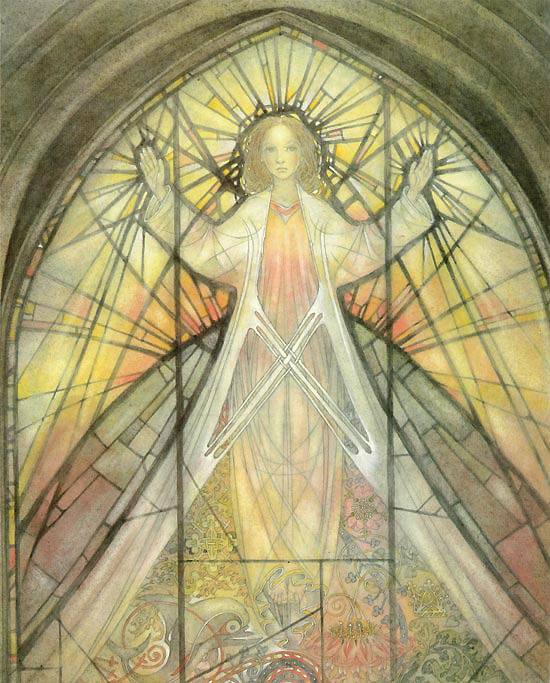
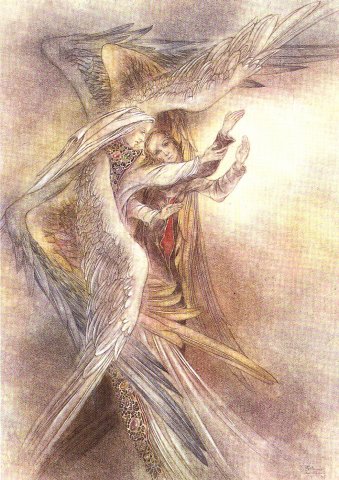
Sulamith Wulfing

All shall be well, and all shall be well, and all manner of things shall be well. – Julian of Norwich

It’s been quite some time since I’ve written anything here, and I look at my stats and marvel.  This has never exactly been the “rock star” of blogs, so I’m always quite surprised when people do comment.  I’m also gratified that the people who do come here mostly seem to be the kind of people I’d want to drop by, so it’s all right.

Speaking of all being right, I note that the last time I wrote, I was anticipating the removal of my “new” knee, the one that seemed determined to grow an infection that wanted to teach me something.  The knee was indeed removed due to this, and I have spent the past two months essentially “bedridden,” as they say, because I found, to my surprise, that there’s not much you can do with only one knee.  I was advised not to put my weight on it nor to bend it, which complicated things further, and so I spent the two months hobbling between my bed and my big living room chair, with an occasional foray to the doctor or into town for a brief outing.  Outings were of questionable worth, because the pain of stuffing me and my straight leg into the car was sometimes worse than enduring the virulent case of cabin fever I developed.  Pain, in fact, has been my constant companion through this, and has been most instructive to live with.  I wish that I could say that it has led to some major spiritual transformation, but I suppose I have been more inclined to just grit my teeth and live through this as best I could.  My husband has been a saint, but that’s nothing new, and it’s possible I may have developed more compassion, because it is always instructive to realize just how rough others have it, and I have certainly have had that opportunity.  Meantime, I am now infection-free, after six weeks of IV antibiotics, and I will go into surgery tomorrow for the implantation of another knee.

One of my favorite “chick flicks,” When Harry Met Sally, had a great line when Billy Crystal, Harry, said that whenever he starts a new novel, he always reads the end first, because he might die before he gets to it, and he wants to be sure he knows how it will come out.  That’s me:  somewhere along the line, I picked up a dark attitude that always expects the worst, so that part of me fears that things will not go well on the ‘morrow wants to be fearful and negative, but if my spiritual betters recommend that I access the “blessed assurance” that says that all not only will be well but wants to be well, then who am I to argue?

Beloved Lord, Almighty God, through the rays of the sun, through the waves of the air, through the all-pervading life in space, purify and revivify me, and I pray, heal me body, heart and soul.  — though Hazrat Inayat Khan

All shall be well, and all shall be well….for All.

Hearing the Sounds of the World

There was a Bodhisattva who attained englightenment by concentrating intently on every sound he heard, so Shakyamuni Buddha called him Kannon.   If you know the substance of the mind Buddha, the very instant you hear a sound, search for this one who hears.  — Bassui, in Philip Kapleau’s The Three Pillars of Zen

There was a time when I aspired to be a scholar.  I suppose that aspiration began when I first found Sufism and read the ancient Sufi mystics and studied the words of my own teacher, Hazrat Inayat Khan.  I read other scriptures, too, and mystical texts, and then I became a college student–rather late in life–and then a grad student and then–worst of all!–a Ph.D. student.  Buddhism always attracted me, and I read and read, but somewhere along the way, I lost my scholarly aspirations and just read and, often, wrote.  I have lost my taste for appearing to know what I’m talking about, and I admit I often don’t, but I know what moves me, and sometimes I want to share that.  So here (after my neurotic apology for poor scholarship) is what the footnote accompanying the above text says:

Kannon is a simplication of Kanzeon, which means “hearer (or receiver) of the voices (cries) of the world.”  Sometimes Bassui uses the term Kanzeon and sometimes Kannon.  (168)

You see, I can’t even be bothered to do a proper reference!   Anyway, there is, in the Buddhist cosmology, a rather loose and–to me–confusing system of Buddhas and Boddhisattvas, and a line of descent (and ascent) that I only vaguely understand and I have run across any number of versions of Kannon, including the female Boddhisattva, Quan Yin, “she who hears the sounds of the world.”  The story about her–sometimes him–is that having attained enlightenment, she was invited into the absolute God, but at that moment, she heard a baby crying somewhere in the universe, and so she decided she should stick around until all sentient beings had attained liberation.  Pretty codependent, eh?  The perfect example of women’s tendency to believe we are responsible for the happiness of all those within our various spheres (and I suppose if you’re a Boddhisattva, your sphere is rather large).  In theory, and in my experience in reality, that principle continues to operate, and it might be said that ultimately, it is the female principle in all of us, realizing our interconnectedness; that we can’t truly go anywhere unless we take everyone else along with us.  Clearly, this is not a popular concept amongst those yet to awaken, but it lies dormant and less-than dormant in all of us.  It appears in virtually all of those religious traditions we know much about:

“The Cross is not a shadow of death, but a sign of progress.” (Teilhard de Chardin, Christianity in the World, 1933, IX, 108)

And of course, to vow to save all sentient beings really is what the cross is about, yes?  To willingly take on the burdens of an unawakened humanity, that the universe might continue to grow and flourish.  Just now, I am having difficulty seeing all that growth and unfoldment, and perhaps it is when we reach those places that such willingness to lay our lives on the line for our ideals is the most important of all.  The writings of St. John of the Cross refer to “the dark night of the soul,” and alchemically speaking, this is the necessary cycle we all go through when we separate the transient from the eternal.  It is a dark night indeed for our mistaken constructs about who we are, and it feels like dying. I’ve been following this contemplative path of mine for nearly 40 years, and recently, a dear friend pointed out to me that there comes a point when we have to accept that the practices and teachings themselves become a limitation and must be dropped for an authentic meeting with the divine Being.  A dark night, indeed, when one realizes that ultimately, the dearly loved icons and ideals are meaningless in the face of the truth.

There is a story which explains this subject very well. It is of a king who had a parrot which he loved so much that he kept it in a golden cage, and always attended to it himself. The king and queen both paid such great attention to the parrot that everyone in the palace was jealous of it.

One day the king was about to go into the forest where the parrot came from, and he said to it, ‘My pet, I have loved you, and kept you with all the care and attention and fondness that I could; and I should like very much to take any message you wish to your brothers in the forest.’ The parrot said, ‘How kind of you to have offered to do this for me. Convey to my brothers in the jungle that the king and queen have done their very best to make me happy, a golden cage, all kinds of fruits, and nice things of all sorts; and they love me so much. But in spite of all the attention they give me I long for the forest, and the desire to dwell among you, free as I used to be before, always possesses my mind. But I see no way out of it, so pray send me your goodwill and your love. One only lives in hope. Perhaps some day my wish will be granted.’ The king went into the forest, and approached the tree from which the parrot was taken and said to the brothers of the parrot, ‘O parrots, there is one whom I have taken from among you to my palace; and I am very fond of him, and he receives all the attention I can give. This is your brother’s message.’ They listened to the message very attentively, and one after the other dropped to the ground and seemed dead. The king was depressed beyond measure. Spellbound, he could not understand what it was that he had said that should have affected the feelings of those parrots so much. The loving parrots could not bear his message. And he thought, ‘What a sin I have committed, to have destroyed so many lives.’ He returned to his palace, and went to his parrot, and said, ‘How foolish, O parrot, to give me such a message that as soon as your brothers heard it, one after another they dropped down, and all lay dead before me.’

The parrot listened to this, and looked up gently to the sky, and then fell down too. The king was even more sad. ‘How foolish I was! First I gave his message to them and killed them, and now I give their message to him and kill him also.’ It was all most bewildering to the king. What was the meaning of it all?

He commanded his servants to put his dead parrot on a gold tray, and bury him with all ceremony. The servants took him out of the cage with great respect, and loosed the chains from his feet; and then, as they were laying him out, the parrot suddenly flew away and sat upon the roof.  The king said, ‘O parrot, you betrayed me.’ The parrot said, ‘O king, this was the aim of my soul, and it is the aim of all souls. My brothers in the jungle were not dead. I had asked them to show me the way to freedom, and they showed me. I did as they told me, and now I am free.’

There is a Sura in the Qur’an which says: ‘Mutu kubla anta mutu,’ which means, ‘Die before death.’ A poet says, ‘Only he attains to the peace of the Lord who loses himself.’ God said to Moses, ‘No man shall see Me, and live.’ To see God we must be non-existent.  –Inayat Khan, The Alchemy of Happiness

Recently, our family watched the recent, acclaimed film Slumdog Millionaire.  I couldn’t really see what all the hoopla was about, but I thought it was important for us Westerners to see just how prosperous most of us are in the face of true poverty and alienation from security of any kind.  And yet:  Indians are said to be among the happiest people in the world!  I tend to think that the more Eastern civilizations are immeasurably richer than we are in the truly important things this world–and the next–offer, and this is why they are such an example to us of real wisdom and happiness.  Unfortunately, the entirety of this film shows that they would increasingly rather try it our way for at least a time, for which I am sorry; but I was moved by the example of a people who live lives that few of us in this culture can even imagine, and continue to prosper spiritually and intellectually.  Perhaps the lesson here is that we are so much stronger than we can imagine, and each annihilation is an opportunity to move from strength to strength building, as Pir Vilayat often said, “a beautiful world of beautiful people.”

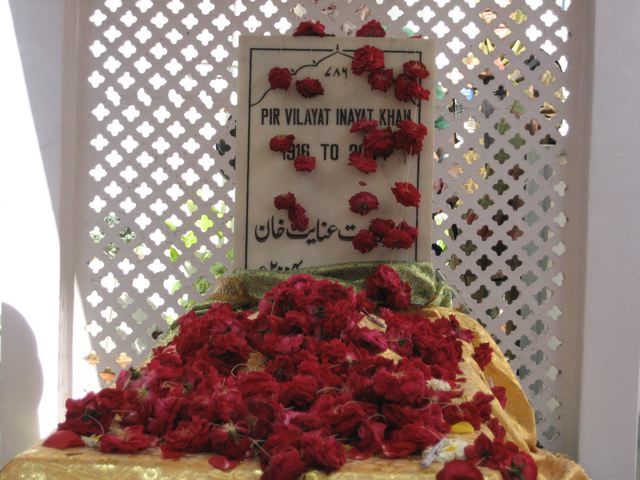
On the Urs

Pir DargahPir Vilayat’s Dargah, Basti

When my Friend is away from me, I am depressed;

nothing in the daylight delights me,

sleep at night gives no rest,

who can I tell about this?

The night is dark, and long…hours go by…

because I am alone, I sit up suddenly,

fear goes through me…

Kabir says: Listen, my friend:

There is one thing in the world that satisfies,

And that is a meeting with the Guest.  — translated by Robert Bly


Following is a letter to members of the Sufi Order International by PirZia Inayat Khan, Pir Vilayat’s son:

Beloved Ones of God,

It gives me great pleasure to greet you on this auspicious day, the fifth Urs of our cherished guide and teacher, Pir Vilayat (may God sanctify his holy secret).

I remember visiting my father in the hospital following his stroke.  I will never forget his words: “I will not be able to travel any more, but I am working on seven levels of light, and I will be with them that way.”

“Them” was clearly a reference to us, the initiatic community of the Sufi Order, to whom my father had dedicated his long life.  He had traveled constantly for our sake, but now he recognized, ruefully, that this would no longer be possible.

Yet he refused to abandon us.  Instead, he said, he would be with us through his work with light.  At the time of his stroke he had been working on an article on the levels of light.  Did he mean that he would be with us through his writings—or did he mean that he would be with us through his own work with light on seven planes?

My intuition tells me that he meant both.  He is with us when we read his inspired words or listen to recordings of his ecstatic meditations.  But there is still more to his legacy.  Even now he is reaching out to us from the inner planes, working to bring us closer to our true selves by means of seven degrees of light.

The best tribute that we can make to Pir Vilayat is to pledge ourselves to the continuation of his sacred and joyous work and to live in the constant awareness of the divine light.

With love to all,

Pir Zia

How to Fall Out of Love

When I was in college many years ago, I had the misfortune–or so it seemed at the time–of falling in love with one of my professors, a man who was older than me and was also married.  In addition, of course, there was an uneven power balance, since I was his student and dependent on his good opinion of me, although I realized later that this didn’t matter as much as I’d thought; his feelings for me were strong also, and caring makes all of us vulnerable.  However, to become involved with someone under these circumstances was not an option for me, nor for him, and we struggled with defining and living our relationship according to our ideals for all the years I was in school.  He had his own problems to deal with (a failing marriage, as I learned later), and our struggles were separate ones.  For me, it was simple:  I simply could not manage to fall out of love with him.  I’m sure it’s a common human experience, and I’m also sure that we all have reasons for our attachments.  Sometimes, I learned, they can be very good reasons, and I suspect it’s even harder to let go when the soul has a purpose in what it presents itself with.

I read a book, during that time, by a behavioral psychologist, called How to Fall Out of Love:  it provided instructions in classic behavioral learning techniques, and suggested methods of “thought-stopping” to bring about the release of obsessive thinking about the other person.  One of these, for instance, was to fasten a rubber band around one’s wrist, and whenever thoughts of the love object arose, to snap the rubber band, causing pain and interrupting the thought process.  Another technique involved fantasizing about the loved person, but imagining him, say, covered with excrement or mucous; something like that.  All this made sense to me, but none of it worked, and I asked myself why.

As the time drew near for me to graduate and move on, I was still enmeshed in my obsessive love for this man, and I grew desperate.  I had no reason whatsoever to think this relationship would ever succeed or could in any way be good for me or for him.  But eventually, it began to dawn on me that perhaps I might want to consider the meaning of the relationship, and rather than running from my feelings, perhaps I should work with them, open to them, accept them.  So I decided to make suffering my semester’s project:  whenever the pain of loving arose, that tense obsession with this person I loved, I would suffer:  I made a practice of going to the department where he taught and sitting somewhere in the vicinity of his office, and then I would suffer.  I would think intensely about him, feel the pain of loving, and draw it in and out of my heart on my breath for as long as it took to resolve itself.  From that time, it took me about six weeks to fall out of love:  I began to understand what this love had meant to me.  I began to see our connection for what it was, and in this case, it was and is a profound connection.  I stayed with my feelings, my pain, the glory of such love, and I opened myself intensely to this profound attachment.  Rather than fighting it, I eventually was able to be curious about it, open to it:  and eventually, like a sore place that is massaged kindly and gently, it became, rather than a painful obsession, just another part of me.  I lightened up.  I moved on.

This person and I continue to be very close to this day.  Our lives have moved in very different directions, and I am very glad indeed that the relationship never became “a” relationship:  we were not meant to be together in this place and time, and I would eventually meet someone who was and is the love of my life.  Behavioral theories tend to make such emotions ridiculous, but the “theory” I developed allowed this feeling to be all it wanted to be to me.  I learned a profound lesson about loving and letting go in the name of love.  I have noticed, over my life, that once I have loved someone, that love never entirely goes away; it becomes assimilated, but it continues to exist, and that is a blessing.

It is only all these years later than I am reminded of this experience as I work with various attachments and painful emotions, learning to stay with them, inquire into them and open to them, rather than running away from them.  I feel myself lightening up, again:  my energy increases, and life is more interesting and less problematical.  This reminds me of another book I liked years back:  Guilt is the Teacher:  Love is the Lesson.  Perhaps love is every lesson, if it is well-learned, and perhaps the core of learning that lesson is to love oneself kindly and with acceptance.

Seeing Fear

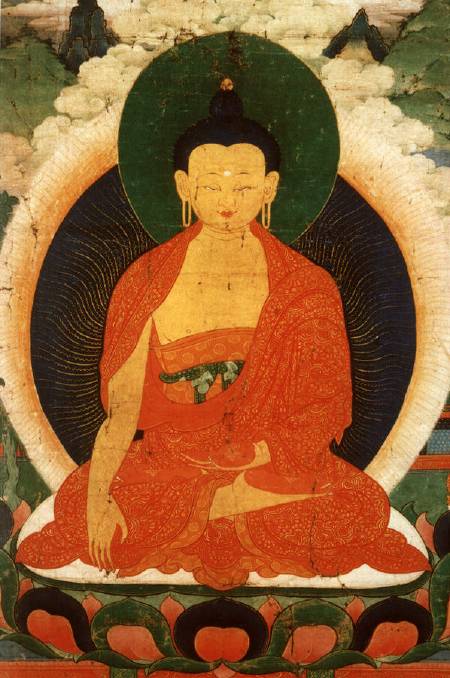
shakya1_jp70

When we give up the hope of doing it right and the fear of getting it wrong,  we realize that winning and losing are both acceptable.  In either case, we have nothing to hang on to.  Moment by moment we are traveling to the other shore.  –Pema Chodron, The Places that Scare You

Right on schedule, it is summer here in the North Carolina Piedmont.  I seem always to have lived in places where the seasons do not arrive and depart with any particular regularity; but here, they seem to:  we always have a short, seldom-really-cold Winter, a long, cool, reasonably dry (where humidity is concerned, that is) Spring, and right on schedule, June 1, the humidity and heat slouch in.  Bona fide thunderstorms, with lightening and heavy rain are regular occurrences, and I, at least, have little desire to live outdoors again until September 1, when the weather tends to start to cool off again.  I find the climate here mostly acceptable, except for those summers:  I do not enjoy humidity, and having lived in Alaska, I am even more adamant about my expectations for the Weather Goddess than I was before I lived in a place with no humidity and no fleas, although abundant with mosquitos the size of Buicks.

But here we are:  it is now early June, and the view from my office window is now blocked by trees heavy with foliage; and thick undergrowth, blocking the pretty barn, rail fences and pasture that were visible during the rest of the year.  This has its own beauty:  the lethargic, still majesty, as the limbs of the trees move lazily with the breeze, simply seeming to be.  The air, when we sit on the porch, is thick and fuggy , and we do not much like it.  I remember when I was a child, prior to central air conditioning, we lived with such weather and viewed it as our lot in life.  I can remember tearing off on my bicycle during the early mornings when it seemed cooler, without a thought for the heat.  But I also remember, when my parents built on a room for themselves with a wall air conditioner, thinking the atmosphere therein was heaven.  We, as humanoids, seem to keep battling with nature, trying to tame it to our satisfaction, and somehow this reminds me of my own inner battle, which I have been observing this morning.

Fear.  I suppose it is something different for all of us, and for me, it is, simply, that I will never be able to meet my expectations of myself.  I am the classic perfectionist, and I often defeat myself, or at least hold myself back, by the deeply entrenched belief that I will never get it right.  As a student of psychology, I can remind myself of the usual explanations of this:  that I internalized a parent of my own making, since my own parents were too caught up in their battles with their own devils to pay much attention to me, and I had little competent parenting.  To a child, or at least to a child like me, what this means is that, a parent being necessary, I had to create one with the aid of my own childlike knowledge of the world and internalize it in my own psyche.  That parent was like a policeman, and it judged and ordered my life mercilessly.  I also learned to accept and absorb the universal, amorphous guilt for all things, beginning with my parents’ compulsions to project their own hatred of themselves onto me.  Thus, I suppose I’m speaking not just of fear, here, but of compulsive, crippling guilt, also.  But I do think that, while these issues can be explained by such transient occurrences, they are but shadows of  larger, planetary ones that emerge as life lives itself endlessly.

So here I was, this morning, settling down to practice, when I became aware of that physical, fluttering, inescapable sensation of fear that paralyzes me so often, particularly when I am alone.  I am in the habit of running from it in my psyche, which only makes it loom larger and draw closer, and I decided, as I have been taught, to face it bravely, with a spirit of inquiry, refusing to run, and see if that helped, as it does when I am able to stay present to it.  And, of course, when I am able to do that, it immediately begins to deflate, like a tired balloon, and quickly becomes of a size appropriate to inquiry.  We humans tend to activate that “fight or flight” response so unthinkingly, so quickly, in such situations, no doubt because of the primordial need to do so when the world was young and so were we;  and that very response has, perhaps, morphed itself into one concerned with inner processes, as our physical safety, as humans, has grown over time.

As I began to breathe more easily, and to consider my fear dispassionately,  I noticed that, for me, fear is grounded in my panic at the thought of not being perfect, of not being thought perfect; that not everyone will love me, that I might say or do the wrong things or fail to do the right ones.  It is, of course, a deep fear of failure.  I think it is a fairly human tendency, although some of us are more able to accept ourselves then others, but it is one that I feel is a central life task for me, in the overcoming of it.  This is one reason why Buddhist philosophy has been particularly helpful to me, being a product of this Judeo-Christian cosmology that forces Original Sin on humans from the get-go.

Recently, I read an anecdote about the Dalai Lama who, in addressing an audience, was asked about guilt.  Evidently, he had a long conversation with his interpreter about this, because he didn’t understand what guilt is!  There is, evidently, no like concept in the East for that painful emotion that drives us Westerners so mercilessly.  There is a difference between remorse, a feeling of regret for not having done the right thing, and guilt; perhaps it is the difference between a sort of musing self-examination and a clear indictment, which I am prone to.  The Dalai Lama, and other Buddhist teachers, remind us that there is a middle way to psychological health, wherein we pause to be fully present to emotions that cause us pain, and consider the true nature of mind, flawless, innocent and pure.  Perhaps it is a process of separating the eternal from the transient.   I have heard it said that the dharma has moved from the East to the West, and while I think such terms are open to much interpretation, I can see, intuitively, how this may be entirely appropriate, given the preeminence of spiritual endeavor in the East, compared to that of worldly pursuits here.  It seems to me that to be human is, at its core, a very similar experience across cultures, but we all seem to have our particular “assignments;” and perhaps, when things get out of balance, we have the opportunity to bring things into balance again, by sharing what we have learned.

In this culture, we speak of faith as an antidote to fear.  Inayat Khan said that the true meaning of faith is self-confidence.  I am currently reading a book by Lenore Friedman, called Meetings with Remarkable Women. It contains pieces about female Buddhist teachers who have been influential in illuminating Buddhism for this culture.  She quotes Roshi Jiyu Kennett:

There is no savior in Buddhism.  You have to do it for yourself.  No one else will meditate for you.  At the time of death you will judge yourself.  The lord of the House will never judge you.  That Which Is, simply is.  The ability to die in peace means the ability to live in peace.  The Cosmic Buddha has no hell to hold over us.  We make our own hell.  The only judging that is done is done by ourselves–and thus we hide ourselves from the Cosmic Buddha.  Everyone possesses Buddha nature (or, as the Christians call it, the soul).  It is only hidden from our view because of our opinions of ourselves.  . . .  The art of meditation removes that separation, so that we can return to our basic nature and truly know it.  Meditation has nothing whatever to do with self-improvement.  It is an extraordinarily deep, prayerful experience, and its purpose is to become one with the Cosmic Buddha–or, if you like, have an experience of God.  –Roshi Jiyu Kennett

It occurs to me that, if I am to be my own judge, I’d better relinquish this created, harsh, mean judge who rides on my shoulders and in my psyche, weighing me down to the extent that I allow it to.  Those of us who practice some form of contemplation learn very quickly that, despite our mind’s tendency to attempt to maintain control, there is a peace that surpasseth understanding that is available, that escorts us into the high realms of the psyche and reveals a reality that heals and nourishes and furthers the unfoldment of all life.

How Could You Not?

Dark Goddess13_JPG


Looking at your face

now you have become ready to die

is like kneeling at an old gravestone

on an afternoon with no sun, trying to read

the white chiselings of the poem

in the white stone.  –Galway Kinnell

If you, my friend, have never read the poems of Galway Kinnell, you must rectify this immediately; that is, if you want to know that it is possible, even here, to produce something that is wholly perfect and sacred and of this world, even in the next.  I always think of his poems during the passages of my life, and I discovered one today,  just as I am going through the passing of her mother with a dear friend.


It is a day after many days of storms.

Having been washed and washed, the air glitters;

small heaped cumuli blow across the sky; a shower

visible against the firs douses the crocuses.

We knew it would happen one day this week.

Now, when I learn you have died, I go

to the open door and look across at New Hampshire

and see that there, too, the sun is bright

and clouds are making their shadowy ways along the horizon;

and I think: How could it not have been today?

In another room, Keri Te Kanawa is singing

the Laudate Dominum of Mozart, very faintly,

as if in the past, to those who once sat

in the steel seat of the old mowing machine,

cheerful descendent of the scythe of the grim reaper,

and drew the cutter bars little

reciprocating triangles through the grass

to make the stalks lie down in sunshine.

Could you have walked in the dark early this morning

and found yourself grown completely tired

of the successes and failures of medicine,

of your year of pain and despair remitted briefly

now and then by hope that had that leaden taste?

Did you glimpse in first light the world as you loved it

and see that, now, it was not wrong to die

and that, on dying, you would leave

your beloved in a day like paradise?

Near sunrise did you loosen your hold a little?

How could you not already have felt blessed for good,

having these last days spoken your whole heart to him,

who spoke his whole heart to you, so that in the silence

he would not feel a single word was missing?

How could you not have slipped into a spell,

in full daylight, as he lay next to you,

with his arms around you, as they have been,

it must have seemed, all your life?

How could your cheek not press a moment to his cheek,

which presses itself to yours from now on?

How could you not rise and go, with all that light

at the window, those arms around you, and the sound,

coming or going, hard to say, of a single-engine

plane in the distance that no one else hears?  –Galway Kinnell

Although the young might not agree with me, I am learning, as I grow older, that it has marked benefits, and one of them is the process of dying.  The reality, of course, is that we are continually dying from the time we are born, and it is as much a part of life as the act of birth, but it is only with the growth of age and, hopefully, wisdom, that we come to really appreciate it.  As Albus Dumbledore, in Harry Potter, remarked, “To the enlightened mind, death is but the next great adventure.”  And so it is, as far as I can tell.  As my soulfriend Carol is reminding me, the death of another is also the death–and birth–of large chunks of one’s own selfhood too.  And we are having the opportunity to examine and appreciate this just now, as her very elderly mother has begun that final journey, the one we take after all the small ones, and the one that begins the next phase, which I suspect is considerably easier in terms of facility.  But it is not easy for the one who experiences herself as being “left,” and it is not easy to watch the one who is “leaving” go through what often looks like terrible suffering.  But it is instructive, too, and if we pay attention, and if the one dying is even the least bit awake, we learn that what we call death is really birth, which begins the cycle of dying again.  In this culture, we think of it as a linear process, but I am more and more convinced it is circular.


Death is nothing at all,


I have only slipped away


into the next room.

I am I, 
and you are you;


whatever we were to each other, 


that, we still are.

Call me by my old familiar name,


speak to me in the easy way


which you always used,


put no difference in your tone,


wear no forced air


of solemnity or sorrow.

Laugh as we always laughed


at the little jokes we shared together.


Let my name ever be


the household word that it always was.


Let it be spoken without effect,

without the trace of a shadow on it.

Life means all


that it ever meant.


It is the same as it ever was.


There is unbroken continuity.

Why should I be out of mind


because I am out of sight?

I am waiting for you,


for an interval, 
somewhere very near,


just around the corner.

All is well.

–Henry Scott Holland

I have experienced the deaths of several beloved teachers in recent years, and these, no doubt because they were very awakened souls who were dying, convinced me that death really is like that:  a new office, another room. . .  But my experience of these beings in this new state convince me that much falls away in terms of actual and imagined burdens:  my dearly loved teacher Pir Vilayat Inayat Khan is, these days, simply radiant with enthusiasm and encouragement.  He was like that when he was here, but he had to deal with all that we do deal with on this plane:  sorrows, resentments, the ego that is so necessary for ballast here, and he doesn’t seem encumbered by those now.  How exciting and encouraging this is!  As I grow, these experiences, this connection with the infinite realities of the universe(s), all convince me that life here and hereafter improves vastly with each leap into the unknown that we make.

But I digress, as always.  I wanted to say something about the powerful and poignant death of our mothers.  These thoughts come from a wholly feminine perspective, because having lost both my parents in recent years, I can say that the death of my father did not have the impact on me that the death of my mother and other women in my family did.  My case is different from Carol’s, because I was not close to my parents:  both of them were personality disordered, probably from profound wounding and trauma they experienced as children, and my mother was a severe alcoholic.  To this day, I wish I could have been more tolerant of their problems, but of course as such parents will, they did me a great deal of harm and not only facilitated my becoming who I am now, but made it fairly hellish to get here, and there is still considerable work to be done.  “Toxic parents” is the phrase commonly used in these situations, but I gave as good as I got in many ways, it is just that they were supposed to be the parents, not me:  but my story is not remotely uncommon, and I have almost grown dispassionate in the telling of it.  In fact, I have almost grown bored with it.  Praise Godhead from Whom all blessings flow!

In my soulfriend’s case, while she had the usual conflicts that arise between mothers and daughters in the individuation phase, she loves her mother greatly and is experiencing great grief in watching her ascent and letting her go.  What a blessing!  For me, who was mostly relieved when both my parents moved on, it is a marvel to see this.  And yet. . .


My mother, poor woman, lies tonight

in her last bed.  It’s snowing, for her, in the darkness.

I swallow down the goodbyes I won’t get to use,

tasteless, with wretched mouth-water;

whatever we are, she and I, we’re nearly cured.  –Galway Kinnell

Recently, I was chatting with the salesperson at the cosmetic counter where I occasionally cave in and buy a few overpriced products, and we were remarking on exactly this topic:  how our mothers live on in us, whether we want them to or not.  She quoted someone, some famous personality she couldn’t remember, as saying that at some point in our lives, we look down at our hand and see our mother’s hand coming out of our sleeve.  The age spots.  The thin, shriveled, but strong fingers, which either do or do not resemble our mother’s physically, but viscerally remind us of that in us which will repeat and evolve itself  for generation after generation.  And this is where Carol and I are one with all women, for the great, dark feminine principle is the world-soul Goddess that thinks herself and grows herself and weaves herself all through the thoughts and dreams of her mind which we ourselves are.

My mother died in the Springtime when we lived in Alaska and she in Florida.  During that summer, not only did her sister, the favorite aunt who cared for me when I was a child and offered a counterbalancing sanity to my mother’s overall insanity, but the adopted and very mentally ill sister I had been estranged from for years, both died as well.  “The Family from Hell” is the phrase oft-used (and only half-jokingly) among social workers and mental health professionals, and that was my family. . .  and it is, today, part of me.  And during that one summer, it was as if there was a “die-off” of the entire feminine in my family, leaving only my daughters and I.  I am afraid that someone reading this might think “oh, you poor thing,” in reading my own account, but that isn’t necessary:  what was necessary, after all the resentment and rage and grief and other emotions I went through in growing away from these women had worn itself out, was to begin to learn, accept and facilitate the part of that dark goddess that had birthed itself in this branch of her being.  And in the end, to give as much respect, grief and honor as I could accord to her/them.  

So, as I sit with my soulfriend while she goes through a very different experience, it becomes clearer and clearer to me that despite our clinging to the experiences and the connections that bring us to this larger realization that we are thoughts in the mind of these archetypes that bring us into being for the purpose of the evolution of God(dess) in humanity, we have the opportunity to not just grieve and rage at the apparent, but to savor the growth in divine awareness that is evolving through us.  As I said to Carol in an email, “I was thinking, last night, that when we really know the loss of our mother is imminent, it is not only our grief over this person who literally birthed and raised us….it is that a part of ourselves is departing, a great, dark chunk of the feminine that is deeply ourselves…  I think that, in reality, that the part of ourselves that is our mother  is actually preparing for a great leap which leads to an even greater incorporation into our beings, but it is like any new phase of realization:  it begins by feeling like death. Even though my relationship with my mother was not a loving or even kind one, it is clear to me that the mother within never dies.  The soul has so many dimensions and each has a journey, but they live on in us, too,  and I can remember when that concept did not make me happy; but I now see that we have to come to terms with it, and I suppose with other deaths, as well.”   But I think it is the death of our mothers and the other women who raised us that affects us most profoundly, as that part of us that has never left the Great Mother prepares to continue its journey.

But these are all very cerebral ideas until we realize them in our gut, and even then we are left with our current reality, which is that we are human beings, and can’t be anything else . . . until we can.


. . . one day the streets all over the world will be empty–

already in heaven, listen, the golden cobblestones have fallen still–

everyone’s arms will be empty, everyone’s mouth, the Derry earth.

It is written in our hearts, the emptiness is all.

That is how we have learned, the embrace is all.  –Galway Kinnell

Pain as the Teacher

I was stunned at the number of people who suffer from it. After a year and a half of being in bed and having my nearest and dearest family and friends around me — and that was sort of it — I felt very cut off from the outside world. I wasn’t working and I couldn’t read and I certainly couldn’t go on my computer, let alone Google something like “pain” or “neck pain.” I had an overriding sense of my uniqueness and isolation. I thought I was the only one, right? How could someone else be going through this? And it felt like a very lonely, isolating and dispiriting experience from the rest of the world. It was only after starting to write the book and being at the … well, being at the hospital first, all of a sudden I was around 60 or so other people with the same problem. That was the first eye-opener; “Oh, there are other people like me and, wow, they even have it worse than I do.” Most of them have it worse, and for all kinds of different reasons. I suddenly had the sense of, “I don’t have a monopoly on pain or on hardship or on family problems or on life-changing incidents.” All of a sudden I felt like my issues were small potatoes compared to the rest of them. . . .   I did start doing a little bit more research and found that there are 50 to 75 million other people in America living with debilitating, chronic pain — which is defined as pain that goes on longer than six months continuously. And then I started finding out that my experience — having to leave work, finding myself isolated and lonely, finding myself depressed, finding myself unable to cope with my family and domestic responsibilities, etc. — was just a common experience that nearly three-quarters of the other people with chronic pain experience also.  – A Life Lived in Chronic Pain: A Conversation With Cynthia McFadden and Lynne Greenberg, http://www.wowowow.com/entertainment/chronic-pain-body-broken-lynne-greenberg-cynthia-mcfadden-interview-266575?page=0%2C1

Presumably, my own current experience of pain will be a finite one, but the interview above was meaningful to me, and I intend to read Lynne Greenberg’s book.  She is a woman whose neck was broken in her teens, during a car accident.  Considered healed, she lived a wonderful life for some 20 years, until a sudden experience of intense pain alerted her that something was wrong, and indeed, it was: evidently her neck had not healed at all, and was still broken.  Since then her life has changed completely, as she has sought healing, but today she lives in chronic, intense pain and is unable to work; and barely able to be a parent.

What struck me so intensely about her very honest words is that pain means isolation:  because we cannot truly feel the pain of another, the best of us offer sympathy and support, while the rest of us offer…dismissal.  What can we do, we think?  And on we go, hoping it never happens to us.

I go regularly to our local hospital for physical therapy now, and I am so struck by the number of people who are living in pain, often alone.  In terms of my own condition, for instance, I am told that many people who live alone go through this, and the thought of that is chilling:  I have a loving husband and daughter who stand ready to make my load lighter and my pain less, who love me and wish me well…  and so many people don’t.

May all people be well.

May all people be happy.

May all people be free.

Soul-Making

a-daily-hymn-resurrection-380x370


Yesterday was my three-week anniversary for my total knee replacement surgery.  I was told that I would begin to see the light at the end of the tunnel by then, but I can’t really say that’s true.  I find it most interesting that, prior to this surgery, the patient is given practically no education as to what to expect, and when questions are asked, “everyone is different” is the standard reply.  Presumably, this is so that the patient will not be scared away and the doctors can continue to perform these very lucrative surgeries.  As you can see, I have little respect for allopathic medicine as it is practiced in this culture, even though I realize that it is sometimes the best choice.  I was pretty sure this was the case here, and I’m still fairly sure, I just wish I’d been told what people are telling me now:  give it a year to really feel great, they say.  Prior to the surgery, I was never able to uncover more than clinical depictions of the surgery, although I admit I may not have tried very hard.  The other day, I came across a “forum” for people who’d had TKR surgery, and it was filled with tales of woe.  I think that if I had seen it ahead of time, I might not have had the surgery.  I remind myself, however, that the people who had good experiences are probably out dancing and playing tennis.  It’s the ones who have problems who write these epistles. I hope not to be one of them, selfishly, but I certainly know how they feel.

If you are reading this, you might ask, is it that painful?  Well, not exactly…  It’s just difficult.  First of all, one’s routines are severely upset, and the smallest thing is now difficult, whether it’s getting into a comfortable position to sleep or brushing one’s teeth.  THE KNEE is always there, and it’s usually uncomfortable.  There are numerous exercises to do, and they help a lot with pain and mobility, even more than the various opioid drugs that are given, which mainly serve to make one feel befuddled and dopey.  They don’t really control the pain, they simply alter one’s perception of it.  I wouldn’t want to be without them, because they help me want to move, which is important.  But my energy level is zilch, and I suppose the thing I resent the most is that I thought it would be better by this time.  “Everyone is different,” they keep telling me, which I interpret as “we’re not going to tell you the truth, because if we did, you’d run screaming.”  

It is rather difficult to find God these days, and as a person who depends deeply on an inner life, that is the most awful of all.  I realize that the idea, here, is to find God in a bottle of Vicodin (hey, it works for House!), despite my vague feelings of guilt about taking these necessary meds, but between the lethargy they induce and that same vague guilt, it isn’t easy.  Of course, there are those moments when S/He/It breaks through it all and says “I’m right here!” As near as my jugular vein.  At these times, one has to find the melody between the lines, between the notes, even.  It is like examining a piece of woven cloth to find the most hidden but necessary thread.  It’s probably good for the concentration, and when found, I am profoundly reassured.

It occurs to me that, just as my Buddhist practices of tonglen and my Sufi practice of Ya Shafee Ya Kafee (invoking the Healer and the Remedy) remind me to use my suffering for the relief of the suffering of the world, so in this particular season, the annihilation and resurrection of the Living Christ provide the ultimate example of how to use my own suffering in this process of soul-making.

Active submission is being receptive to the intelligence of Spirit and living accordingly. Its opposite is the neurotic anxiety and compulsive living that is accepted as normal today. Active submission, the natural state of the essential self, dissolves selfishness, transforms anxiety and fear. At the same time, because it establishes a connection to Spirit, it unlocks our finest and noblest capacities. Because we have cut ourselves off from Spirit, we have swelled with false pride and thrown the world out of balance: Our bodies and minds, our relationships, and our whole ecology is suffering the consequences. The human being has capacities which are unsuspected today and which can only be known through a balance of spiritual submission and energetic activation in relation to our life in the world. –Kabir Helminski, http://www.sufism.org/books/sacred/alien.html

And in this, I suppose, is yet another form of the dhikr.  Either God has a peculiar sense of humor, or God makes available to the seeker the deepest experience of love.

Pushing Through

Oy, da pain….! Only my enemies should know such pain…. –The Bubbie, in Crossing Delancey

I’m in Day Three after coming home from the hospital after my first total knee replacement surgery.

I am not having fun. I just want to go on record as saying that right now.

Not only am I not having fun, I am beginning to lose my belief that there will ever be such a thing as fun again.

Not only am I not having fun, I am no longer a spiritual person who believes in seeing the meaning in all experience, in order to be lifted–along with the rest of humanity–to a higher plane of existence and limitlessness. I would, in fact, just settle for a decent night’s sleep, one in which I did not have to spend hours trying to re-teach my body how to settle into a position that will not hurt and will allow me to leave it behind for awhile.

My hair has not been washed in nearly a week.

My new knee is swollen to the size and appearance of a Scottish haggis. Apparently this is “normal.”

I do not enjoy taking the opiates that have caused such a frenzy of addiction and judgment in our culture. They probably have their uses, and this is probably one of them, if only because I am more willing to go through the rehabilitation exercises and movement required to make this thing work, but I do not find them fun.

I gather that some people do. Damn.

My mouth tastes like the bottom of a birdcage. The aforementioned drugs cause this, and cause such dryness that I wake up with my mouth glued shut in the night. I imagine I may have friends out there who think this might not be such a sad state of affairs, but friends….it is not fun.

We are having a lovely, but sometimes rainy Spring here in the Piedmont, and this, for some reason, causes my house to smell like an old catbox.

We do not have a catbox. We have a cat, but she knows her place.

My house looks more and more like a hospital emporium, with stacks of generic stuff in every room, while I try to figure out how to live through this time. My poor husband, my guardian angel, tries to keep up with my carping and ongoing demands, while sorting through it and maintaining some semblance of order and peace, both of which are very important to me.

I am not a nice person. I am a greasy, cranky old woman who is increasingly disinterested in any of the support mechanisms I thought would get me through this.

Tell me, why do people have cable TV? Nearly one hundred channels, and not one damned thing worth watching.

I can’t sit at my big computer (I’m on my iBook at the moment, kicked back in my armchair with my leg supported by a stack of pillows), because my leg is too stiff to fit under it. No fun for me.

I have fantasies of gangrene, death, unremitting misery. I feel like Billy Crystal, who in When Harry Met Sally mentioned that he was such a dark personality that he always read the end of a novel before the beginning, because if he died before finishing the book, he’d know how it came out.

My inherently Jewish soul emerges in this night of pain, beckoning me to suffer well and to keep a sense of humor about it.

I am not sure I am doing this, but there doesn’t seem to be much else to do, so I keep trying.

If a man die, shall he live again? All the days of my appointed time will I wait, till my change come. — Job 14:14 Bible: Hebrew

Nothing to do but wait. And wiggle my toes.

Amen.

Back online…sort of!

Here is a brief groupmail that went out to friends and family today.  I’m a bit loopy at this point, but all goes well.  I’ll write some more when I am a trifle more coherent….
David carried me home today (as they say here in the South), and it’s good to be back under my own roof, but I have an entirely new set of problems with living that I didn’t have before this.  I’m glad I went through it, and I am assured that all went very well indeed, so well that on the first day, after surgery, my doctor was so impressed with my bold attitude (“so when can I have the other one done?” he reports me asking, right after I admonished him “now don’t screw up.”  Evidently, he enjoyed all this.  The only bad part is that it caused him to decide I didn’t need the morphine IV drip most patients get, and the other pain control measures, feeling that the epidural would carry me through after the spinal injection wore off.  It is an amazingly elegant protocol for surgery, keeping me very balanced throughout, but the aftermath–without drugs–is not to be recommended, and by that first evening, I was on the drip and feeling vastly reassured.  Things went well after that, and I am supposedly healing well, but a hospital is no place to do that, let me tell you.  It is like convalescing in the middle of a convention of some sort, with something going on everywhere around one.  One tends to get forgotten rather easily, especially when one is in some sort of predicament, i.e., waiting to be helped out of the bathroom, for instance.  As well, the body doesn’t quite seem to know how to do what it once did, and  rather like having a baby, one must re-teach such activities as sitting up and bowel movements.
I have suddenly retreated into the far North (my head) and my legs and feet have seceded to the deep south, another land entirely.  I do sincerely believe in the body’s ability to heal itself, but it is not always the kindest of healers, and it utilizes its needs to make one re-learn one’s own basic abilities.  Why just today, I find I can perform such daring feets as a pleasant stroll down the hallway with my walker, and my personal favorite:  straightening my knee entirely.
On the unit, one would hear occasional stories of a patient who had had both knees done at once, and that these were not nice people, evidently.  I can only imagine, but I think I will be in good shape for doing the other knee, after this one heals.
To all of you who sent flowers, made phone calls that I actually picked up amidst my morphine haze, and sent cards and the like, much gratitude.  The emotions are so sharp during times like this, and these gestures of love are so healing.  To my darling David, who made himself my loving support in all things and allowed himself to be snarled at and leaned on, often simultaneously, and still seems to love me, as I do him, well….this is just what love it all about, that’s all.  It just is…you know?
“Blessed is he who sees the star of his soul as the light that is seen in the port from the sea.”  Inayat Khan

About being Healed with Steel

Sulamith Wulfing

Surgery is limited. It is operating on someone who has no place to go. – John Kirkin, M.D.

I have clung to ideals of natural diet and healing since my teens.  I have steadfastly believed that the body, with a little help from its “friends,” was entirely capable of healing itself.

I go in for surgery tomorrow morning.  I have no place else to go.  I have had to turn to this because, despite my best efforts:  diet, exercise, supplements, herbs, homeopathy, etc., etc., etc., throughout nearly ten years, my joints have continued to deteriorate, and now my knees, at least, are so damaged that I honestly believe this is the best decision, and that it is one I probably should have made sooner.  I have problems in other joints, but these are the ones that cause me the most psychic and physical pain:  For many years, I have had dreams of walking down a road, slower and slower, finally being unable to go further, and this has acted itself out in my life here on this planet.  I have, in recent years, had what Freud called “wish fulfillment” dreams:  dreams of running, standing, dashing here and there, and these dreams cause me to think that this is a clue my true being wants me to notice.  “You don’t know what you’ve got til it’s gone,” and I want to tell my children, my friends, my beloveds, “don’t let this happen to you!”

The question, of course, is whether we really do have the control over this kind of thing that we think we do.  It has occurred to me that all this preoccupation with herbs and the like might be, for me, more a function of my need to control than anything else.  If I just do A, B and C, perhaps the inevitable won’t happen, I think…and, sometimes, it works, and other times…it doesn’t.  It didn’t in this case, and I ask myself, out of the same need, what I did to cause it.  After all, to think that I am the dupe of a heartless universe that accords me no control whatsoever over what happens to me is unbearable:  I’d rather think that I caused it, and I can “cure” it.  Some of this, of course, is the impression this Judeo-Christian culture with it’s inherent blaming attitudes leaves on most of us in this part of the world:  “Shame on you!  If you’d just eaten more vegetables, lost weight, done more exercise, etc., none of this would have happened!”

I am more and more influenced by Buddhist thinking, which I am coming to believe is the consummate psychotherapy for our Western culture, and I am learning to consider these matters without coloring them with my “stories,” most of which arise out of the world-view I was raised with.  If I consider my current predicament without adding the blame and the many explanations I might accord it, I find that I have more energy for healing and inspiration.

I am also finding that when the chips are down, one is empowered in this kind of thinking, which allows for more openness to larger explanations and even a larger support in adversity.  “Cling to Allah in prosperity and surrender to Him in adversity,” as the Hadith of Mohammad (peace be upon Him) says, and that understanding can take many forms.  In that surrender can so often be one’s greatest experience of greatness, both within and without.  I am very aware, these days, of the vast support network that is here for me, and to the extent that I am able to release what binds me to limitedness and open to vastness, I can make use of that network.  Thus,

I take refuge in The Buddha The Dharma and The Sangha
I take refuge in The Guru The Yidam and the Dakini
I take refuge in The Bodhisattvas The Protectors and The Tantras
Homage to all of you

As long as there is suffering
As long as there are sentient beings in the 6 realms
May I never attain Enlightenment
And never cross over into Nirvana

The problem that I have, and that most people have, is continually understanding that I am one of those “sentient beings.”  Being loving and compassionate with me is not something this culture–and my own personal background–has made easy for me.  But I am grateful for the opportunity of this moment to learn a further lesson in loving the cosmos as myself–and vice versa.

When we look at the surgical world, no doubt wonderful operations are being done, and humanity has experienced great help through surgical operations; yet it is still experimental, and it will take perhaps a century longer for surgery to mature. It is in its infancy just now. The first impulse of a surgeon is to look at a case only from one point of view, and to think that this case can be cured by surgery. He has no other thought in his mind, he has no time to think that there is another possibility. If he is a wise surgeon, he gives a word of confidence; yet he knows that it is an experiment. It is a person he is dealing with, and not a piece of wood or a stone that can be carved and engraved upon. It is a person with feeling, it is a soul which is experiencing life through every atom that it has, a soul which is not made for a knife. Now this person has to go through this experience, fearing death, preferring life to death. Very often what happens is that what was considered wrong before the operation, is found to have been right afterwards. No doubt something wrong has to be produced because the operation has been performed. And an operation is not something that is finished; it is something which has its action upon the nerves and then upon the spirit of a man, and then its reaction upon life again. Do we not see that after an operation a person’s whole life has become impressed with it? A certain strain on the nerves, a certain upset in the spirit has been caused. The care of the surgeon continues only until the patient is apparently well, outwardly well; but what about the after-effect of it on the spirit of the person, on his mind, its reaction on his life? The surgeon does not always realize this, he is not concerned with it.

Cure means absolute cure, within and without. By this it is not meant that surgery has no place in the scheme of life. It is a most important part of the medical world, but at the same time it must be avoided when it can be avoided; one must not lightly jump into it.  –Inayat Khan,  Healing and the Mind World, c. 1920s

It is this kind of thinking I was “raised” on, in the sense that my spiritual mothers and fathers gave me the real parenting I needed, and it is this thinking that I have to assimilate within the clear impulse of this moment.  “If you meet the Buddha in the road, kill him,” as the saying goes, and I must “shatter my ideals upon the rock of truth,” as Inayat Khan also says.

I take refuge in all the masters, saints and prophets who form the body that governs the universe.  I take refuge in the archangels, angels and elementals that uphold, serve and heal the planet.  I take refuge in the Spirit of Guidance of which all these comprise the body of Reality, the Being of God.  May all beings be well.  Including me.

Arthroplasty

I have been living with an autoimmune disease for some years now, and it has taken its toll on my joints, particularly my knees.  I am one of those people who has extreme control issues:  in this case, the assumption is that I can control my condition myself and don’t need allopathic medical science to do it with, thank you very much.  I went through years of supplements, glucosamine, homeopathy, yoga, meditation, and lately, what I call my “beans and greens” diet, i.e., a mostly vegan diet that stresses vast amounts of green vegetables and little protein.  It has worked, in the end, better than anything, and cost a helluva lot less money.  But it hasn’t made my joints grow back.  So much for my belief that I can control this!

Last week, I went for x-rays, and my doctor said that my knees are in the upper ten percent of the worst knees he’d ever seen.  Well, he’s young, but that did make me gulp.  He seemed particularly surprised that this was happening at my age, which is a young 57.  [Gulp]

So I am going to bite the bullet, as it were:  I am going to have both knees replaced, and I am going to start with the one that is worst, the left.  I’ll be having surgery in less than two weeks, and I will admit that I am terrified.  On the one or two occasions I’ve had surgery in the past, I’ve had, well…interesting…experiences with the anesthesia.  Not fun at all.  However, it seems that nowadays I can have an epidural and a sedative, which may be much better.  Sort of like having a baby, I suppose.  I am also told to expect significant pain, and it will take me awhile to recover, during which I will have physical therapy and the like.  

I thought I would post here about this process, because there may be people out there who are considering this procedure and might like to know someone who is going through it.  I certainly felt that way.  

What I can say, at this point, is that I am very aware of what Inayat Khan said about such things:  “shatter your ideals upon the rock of truth.”  Increasingly, I am finding that what seems apparent to me is not necessarily what is transpiring.  In this case, it seems that I am being given an opportunity to adjust my judgments about allopathic medicine and also to find out for myself that I am stronger than I think I am.  I began this process with I had my second child at home.  Home birth is a great experience in empowerment.  The difference is that you get a prize at the end of your birthing experience, and after knee surgery, you get to become strong through pain and difficulty.  What a gift!

I’ll keep you posted.

Irony

img_1719_2

I live in the Piedmont Region of North Carolina these days.  After living in such places as Alaska and Massachusetts, I have had considerable difficulty acclimating to the steamy, hot summers and the pretty-much-nothing winters.  Over the weekend, my husband and I went for a drive to take pictures of the various huts and barns from long ago that still stand in abundance in the countryside around us, and we marveled at the also-abundance of daffodils, which started to bloom in mid-February.  Perhaps you can see them in the photo above.

They got their comeuppance, though, when we got up to this, this morning:


snow

Is this an example of God’s sense of humor?  We have been longing for snow for months, and had pretty much given up…


SNOW 

Let Thy knowledge cover my heart 

as the snow covers the ground. 

Let my heart melt in Thy light 

as the snow before the sun. 

Let my heart show the purity of snow 

in the path of righteousness. 

Pour on me Thy eternal life 

as snow on earth. 

Make my heart delighted 

by the snowfall of Thy knowledge of Truth.   –Inayat Khan


We are three, You are three

santa-sabina

When I was a doctoral student, I used to attend graduate residentials that were held at a wonderful place called Santa Sabina, in San Rafael, California.  Although the first time I went there was for this very earthy academic event,  I learned immediately, because of the wonderful, holy atmosphere of the place, that Santa Sabina was something very different than I’d thought it would be.  At that time–and perhaps now, as well–it was a Catholic convent on the campus of Dominican College in San Rafael, a convent that was no longer a convent, but had been turned into a conference and retreat center.  It hosted many different kinds of groups, from the one I first attended to contemplative retreats for numerous spiritual groups.  Its atmosphere is beautifully universal:  Mary shared space with Buddha in the Garden, and the entire place echoed with an atmosphere of peace and holiness.  After that first visit, I always arranged to stay there for a few days when I was in that part of the world, and I came to know and love the women who ran the place.  It was my “home away from home,” in the highest sense of the word.  I haven’t been able to go there for many years now, but I carry it in my heart, always.  It may well be the place I have felt most at home on this planet and in this world.

One morning when I was there many years ago, I found myself in conversation with an elderly nun, one of the last of those who still wore the habit, a very wonderful soul.  She told me a story, and I have tried to remember that story for many years, until I just found it in a book called Soul Food, by Jack Kornfield and Christian Feldman, a collection of transformative stories from many different traditions.  A wonderful book.  Here is the story:

When the Bishop’s ship stopped at a remote island for a day, and he determined to use the time as profitably as possible.  He strolled along the seashore and came across three fishermen mending their nets.   In pidgin English they explained to him that centuries before they had been Christianized by missionaries.  “We are Christians!” they said, proudly pointing to one another.

The bishop was impressed.  Did they know the Lord’s Prayer?  They had never heard of it.  The bishop was shocked.

“What do you say, then, when you pray?”

“We lift eyes to heaven.  We pray, ‘We are three, you are three, have mercy on us.’”  The bishop was appalled at the primitive, the downright heretical nature of their prayer.  So he spent the whole day teaching them the Lord’s Prayer.  The fishermen were poor learners; but they gave it all they had, and before the bishop sailed away next day he had the satisfaction of hearing them go through the whole formula without a fault.

Months later the bishop’s ship happened to pass by those islands again and the bishop, as he paced the deck saying his evening prayers, recalled with pleasure the three men on that distant island who were now able to pray, thanks to his patient efforts.  While he was lost in the thought he happened to look up and notice a spot of light in the east.  The light kept approaching the ship and, as the bishop gazed in wonder, he saw three figures walking on the water.  The captain stopped the boat and everyone leaned over the rails to see this sight.

When they were within speaking distance, the bishop recognized his three friends, the fishermen.  “Bishop!” they exclaimed.  “We hear your boat go past island and come hurry hurry to meet you.”

“What is it you want,” asked the awe-stricken bishop.

“Bishop,” they said, we so, so sorry.  We forget lovely prayer.  We say, ‘Our Father in heaven, holy be your name, your kingdom come. . .’  then we forget.  Please tell us prayer again.”

The bishop felt humbled.  “Go back to your homes, my friends, he said, “and each time you pray, say, ‘We are three, you are three, have mercy on us!’”  –from Soul Food:  Stories to Nourish the Spirit and the heart, by Jack Kornfield and Christian Feldman, Harper San Francisco, 1991

The sister who told me the story told it just a trifle differently.  When the fishermen (which is how she referred to the three men, and told the story as if they said their prayer from their boat on the often dangerous and frightening high seas) came flying across the surface of the water and spoke to the Bishop, they confessed that they could not remember the Lord’s Prayer as he had taught them.  They said that they could only remember their original prayer:  “Three in a boat, Three in Heaven, have mercy on us.”

The old nun paused here, and her face twisted into an ironic grin.  She winked at me as she told me what the Bishop said to them:  “Keep it up.”

I will always remember this woman’s last words to me:  “We all need more faith.  That’s all we need.  More faith.”

Dhikr

IMG_4116

“Die before death and live forever.”  Pir Vilayat Inayat Khan

         Dhikr is possibly the central practice of most Sufi Orders, and of course there are many ways of doing it and saying it and chanting it and singing it.  It is the core of the Dervish ceremony, of course, there is a great deal of lore out there about its practice and the miracles it brings.  Some form of it appears in all the esoteric schools:  the Kyrie Eleison (God have mercy of the Desert Fathers, the Hesychasts), the Ein Keloheinu of the Chassids (There is no God but God) and, I think, Om (relating to Brahman, the Absolute) and Om Mane Padme Hum.  All I can do is tell you about it from the perspective of what it has given to me over nearly 40 years of practice.

         My teacher, Pir Vilayat Inayat Khan, pointed out early on that the most apparent difference between dhikr and wazifa—or mantra—is that the practice of a mantra is about experiencing and enjoying the divine qualities of whatever it is we call God. Dhikr, on the other hand, is beyond that:  it is about remembrance, coming home to the reality of God, beyond the qualities, beyond worlds and universes and beings…  Dhikr is the way God really is.  And if one is going to come home to That,  one must go beyond temporal  things and into the Absolute…where one finds oneself coming and going.  I suppose it just depends on one’s intention and one’s  travel plans when one embarks on this journey.  If done properly, it is not child’s play.  It is an advanced practice, and should be undertaken only with the help of a trusted guide.  Of course, having said that,  we must then give thanks for “all those, whether known or unknown” who have bravely, and with sincerity and commitment,  taken the journey when it was there to be taken.  However, I suspect there is always a guide where the intent is true, whether seen or unseen.  I have found this to be true in my own practice, again and again.  The Sufis say there is really only one Teacher, the Spirit of Guidance, and that This permeates all seeking.  Perhaps key to a safe and successful journey—or rather, this particular leg of the journey—is sincerity.

         I experience dhikr in approximately four stages, each of which is its own world of understanding.  First is what some would call the abasement, or the dark night of the soul, in the alchemical terms my teacher loved and taught:

“La illa ha…”  There is no God, there are no beings…

             In that dark night of unknowing, as St. John of the Cross called it, one turns away from and relinquishes all one’s concepts about reality.  Classically, this is done sweeping the head in a sort of clockwise circle, a gesture of negation:  “all that I thought to be true about the world and God and reality…was a lie.”  One is annihilating one’s concepts (not oneself).  That comes next.

     Bringing the head down to the chest,

“Ill’a”

 One stabs one’s own heart with a lance of light from the third eye.  It is a symbolic crucifixion, wherein one annihilates—again, not oneself—but one’s concept of oneself.  “All that I thought I was and am, none of it exists, and none of it matters.”  There is a sense of having destroyed all one’s concepts about oneself and the world and God, and what is left?  The Alchemists call it “dissolution,” in the classic formula, where what is gold is separated from what is lead.  Out of this, a sun rises, a flower blooms, the resurrection takes place:

 “Allah”

      Having realized what one is not, there is a new birth, because in the annihilation, a new seed is planted, the seed of a new soul.  The crucifixion of Christ beautifully represents this, and there are numerous similar stories about Sufis and other mystics who undergo this process.  Al Hallaj, for instance, who was dismembered because, while in the state of God consciousness, he said, “I am the truth.”  Finally,

“Hu.”

      And that is the fragrance that persists after the flower has long gone to other seed.  It is what our lives are about:  the dhikr sings itself through our days and nights, and it is the meaning within it all.  I find that it is both the symbol and the reality of this journey I’ve undertaken, and it weaves itself through all adventure.  It evokes the words and pictures for a new kind of story, and helps me to forget the stories I have fabricated to make my life bearable, so that there is now the possibility for a new song, a new story, a clear playing field.

     The outer forms of religion are just that:  outer forms.  The words that reveal our travael plans are only words.  I have had, in the second stage of dhikr, when my third eye meets my heart, perceived an enchanting desert scene that seems planted right there:  it is twilight, and the colors of the landscape are all pinks and mauves and fawns.  Stars twinkle overhead.  I stand on a soft, dusty road, walking into that twilight, and somehow I know that I am waiting at the other end of it…

But is there an end?

c87fc5d3-fd92-44b8-b0e2-ee979b43245f


The Message is a call to awakening for those who are meant to awaken, and a lullabye for those who are still meant to sleep.  –Hazrat Inayat Khan 

How Do We Forgive Our Fathers? by Dick Lourie*

How do we forgive our Fathers?
Maybe in a dream
Do we forgive our Fathers for leaving us too often or forever
when we were little?

Maybe for scaring us with unexpected rage
or making us nervous
because there never seemed to be any rage there at all.

Do we forgive our Fathers for marrying or not marrying our Mothers?
For Divorcing or not divorcing our Mothers?

And shall we forgive them for their excesses of warmth or coldness?
Shall we forgive them for pushing or leaning
for shutting doors
for speaking through walls
or never speaking
or never being silent?

Do we forgive our Fathers in our age or in theirs
or their deaths
saying it to them or not saying it?

If we forgive our Fathers what is left?

* This poem is read during the last scene in Smoke Signals. It was
originally published in a longer version titled “Forgiving Our
Fathers” in a book of poems titled Ghost Radio published by Hanging
Loose Press in 1998

From one of my all-time favorite films.  The film is about the experience of being Native American in this country, but I believe the theme is universal, particularly for those of us from the “wonder years.”  Please do see it.  You can Netflix it!  And do scroll down for the nice video of the actual scene that a kind reader posted here for us.

Mindfulness


cedar-51

During a long retreat, I had what seemed to me the earthshaking revelation that we cannot be in the the present and run our story lines at the same time!  –Pema Chodron, When Things Fall Apart


I have mentioned, here, that I am recovering from a chronic autoimmune disease.  I say “recovering,” because why on earth would I want to say I won’t recover, even with the use of words such as chronic?  If you are reading this and you happen to have such a disease yourself, you no doubt know that these things progress in weird fits and starts, with flares and periods when one feels almost completely well, with long phases in between these extremes when one simply…manages.  Over the recent holiday period, I had a major flare-up of pain and inflammation, which I blamed on the several small indiscretions I committed with food:  I follow a strict vegan eating plan with vast quantities of green vegetables and legumes, and it helps–quite a bit.  But during holidays, of course, we are all inclined to stray from our various paths, and food, of course, is an intrinsic part of celebration among the human family.  I’m not sure if this is good or bad, but I am sure that this is so.  Food and drink are the ways we connect with our other parts, whether or not we think it is okay to do so.  

In any event, the point is that I was blaming myself pretty heavily for the chocolate and the wine and the ice cream and the meat and the various other “bad” things I indulged in, and it suddenly occurred to me that this is just another one of my many stories, most of which state “this happened because I am a bad person,” in some form or another.  

Now, I have been working with this idea about “stories” for a year or more; I find it incredibly helpful, and it is particularly liberating for me, a committed Jungian, because I have long looked at the world through the various lenses of the myths I’ve created to get me through life.  It was an amazing revelation to me to see that these myths–stories– really, really limit me and keep me from seeing things clearly, in addition to curtailing any attempts I might make at true mindfulness.  If I look at phenomena in terms of the story I’ve attached to it–“I can’t get the window unstuck because I am a weakling, just as my mother and father said I was,” for instance–I lose the moment and the opportunity to really inquire into the events that come my way.  

So there I was, beating myself up for eating chocolate, and I thought, “what if I just ate chocolate, not ate chocolate because I am a glutton” (word used by my father when I was small and wanted to feel satisfied)?  Ahhhhh.  Fresh influx of energy and inspiration, weight lifts from shoulders, I am free.  I am here.  The pain lifts–or, rather, I look at it differently, and it isn’t quite so miserable.  What a blessing.  The air is clearer.  I notice the beauty around me.  I feel blessed and grateful.

I am a person who struggles with depression.  The years have taught me that much of my depression is connected with the interpretations I give my feelings; in other words, the stories I tell myself to explain why this or that is happening, or why I feel the way I do.  Looking at what is taking place without attaching a story to it–or at least releasing the one I am compelled to attach–has the effect of making the feelings of sadness or desperation or resentment…nonexistent.  I have learned, through years of struggle, that usually, just waiting it out is the best way to deal with any of these painful feelings, and the wait is far shorter when I get my mind off the stories attached to the feelings and onto the present moment, which is quite often very beautiful.  Even if it weren’t–and obviously, much of life is not for many people–being fully present means I live life in increments and each one, in and of itself, is really pretty much okay, until the next, and often it is, as well.  

This is not an easy pattern to break, but after all:  nothing worth having is easy, and this is very much worth it to me, this relinquishing of my stories to be present to what is, this very moment.  Last week, in much pain and exhaustion and the overall malaise that tends to accompany autoimmune disease, I woke up after one of those miserable nights of sleeplessness and despair, and as I noticed the sun coming through the window, I suddenly realized I felt…taken care of.  In that moment, I felt loved and at peace and accepting of myself.  I felt grateful.  

It occurred to me that the reason I was feeling these good things was that I was there, not running some story from the past or connected with fear of the future.  Here was a sunny morning and a down comforter and the thought of a cup of Darjeeling tea and the opportunity to stay here, right here, not go somewhere else in my mind or my car, and in this moment was pure gratitude.  I blessed the cup of tea and I’ve continued to bless everything I can think of since, to give thanks, to be present and most of all, not to worry.  If I worry, I am running my stories again, and it’s not worth it, doesn’t change a thing, in fact:  it only makes things worse.  

It occurs to me, as I think about all this, that many of us–perhaps most of us–are not quite ready to give up our stories yet.  If we do, we get ourselves free, and there is the feeling of a death-wish in that prospect.  I think I’m ready.  I remember my beloved teacher, Pir Vilayat Inayat Khan once saying that if we think, in reaching the higher realms of the psyche, that we are going to somehow float off like a balloon into the blue, become nonexistent, die, etc., etc.  (all the fears that cause us to continue to use our egos as ballast for our fears), we are mistaken.  He laughed when he mentioned this, and said, “don’t worry, it absolutely will NOT happen.  You will come back.”  What we are all talking about, here, is awakening, and our fear of it, because we tend to be stuck–purposefully stuck–in the ultimate story:  if I die, awaken, become free, relinquish my concepts of reality, whatever form the story takes for each of us as individuals, I will become nonexistent.

It’s not going to happen.  He was right.  Instead of death, the opportunity is offered to us with every breath, to take up an enhanced, enriched, meaningful, awakened existence.  Going beyond my stories doesn’t mean death, it means I’m adding immeasurably to all of life.  Instead of looking at the trees I see sitting in the rocking chair on my front porch while trying to think how to write that next chapter or pay this month’s bills or get my hair to go in the direction I want it to go in–yes, I really am that shallow sometimes!–I am…looking at trees.  Noticing how the bare branches of winter look against the pale blue cold-weather sky.  Listening to them murmur about way more important things than I can hear in people’s voices.  Really, really hearing the sound of trucks going by on this farm road we live on.  Hearing the Sound within the sound they make.  Noticing the squirrels attempting to get into the bird feeder, and wondering why we feed the birds but not them.  Being here.  In that moment, if I am truly in that moment, the chattering in my mind ceases, and when the moment comes that whatever those voices were chattering about must be dealt with, it is never quite what my stories warned me of.  

Between birth and death,
Three in ten are followers of life,
Three in ten are followers of death,
And men just passing from birth to death also number three in ten.
Why is this so?
Because they live their lives on the gross level.

He who knows how to live can walk abroad
Without fear of rhinoceros or tiger.
He will not be wounded in battle.
For in him rhinoceroses can find no place to thrust their horn,
Tigers no place to use their claws,
And weapons no place to pierce.
Why is this so?
Because he has no place for death to enter.  —Tao te Ching, 50, Gia Fu Feng and Jane English, trans.

Pardon my levity, but is this what they really mean by “the Teflon [hu]man?”  Well, it works for me.

A New Day

Since the joy of the election and yesterday’s inauguration, I’ve been having a song go around in my head.  It’s a song from my own youth, from one of our premier spokespersons:

Hey Hey, Woody Guthrie, I done wrote you a song

‘Bout a funny old world that’s a comin’ along

Seems sick and it’s hungry, it’s tired and it’s torn…

It looks like it’s a’dying and it’s hardly been born.  –Bob Dylan (paraphrased in my head)

The emotion of these past weeks has been, for me, like waking up to springtime after a long, dark, cold winter, and I am well aware that I am not alone in this.  I am one of those people who, deciding that there is no point in trying to fix what seems unfixable, tends to pull the covers over my head and wait for the dawn.  I do not recommend this, but it is the way I am.  Currently.  

I find myself wanting to do what we’re all doing, which is get all teary-eyed and sing praises to Obama, but I thought I’d try to resist that and reach down to a deeper need, which is to consider all this on a–hopefully–more cosmic level.  The voices in my head are like beads that have fallen from a string, confused and clamoring against each other as they fall and land and I pick them over…  comments from my children, my husband, friends, colleagues, news commentators…  various beads, various themes, evoked by the real strand of meaning strung by time, and several stand out:  the first one is the length of time and the amount of damage it has taken for us to get to this day.  It was so heart-breaking for me to hear that Ted Kennedy had had a seizure and been taken to the hospital.  It brought up the night, long ago, when his brother Bobby was shot and I, a lonely and alienated teenager, sat up all night listening to the radio and praying.  In a sense, I feel fortunate to have lived in times when such astonishing events have happened, facilitated by those who stepped up to the plate:  the Kennedys, Martin Luther King, the many brave figures of the civil rights movement in general, the Sixties… I feel as if I ought to mention so many names here, all golden beads on that strand.  And then there are the Presidents who stand out:  Jimmy Carter, a true humanitarian and bona fide Holy Man (yes, upper case intentional), Bill Clinton, a man flawed but capable and caring (and let’s not forget Hillary, who ought to come first, and we’ll see if she can get out from behind the shadows of those who would push her back into them)… and slipped onto that strand that ripples and breaks and reforms endlessly, the dark ones, too, most notably He Who Must Not Be Named,  as he has long been known in our household.  My own lifetime, as all lifetimes on this planet are, has been filled with blood, guts and glory, as they say, and perhaps most of us ask ourselves time and time again if it’s all worth it.  Moreover, what does it all mean?

This is where we get cosmic, because it seems to me that rather than think, at this moment, in terms of people, personalities or events, it is the overall meaning of them that is important to consider as we charge forward, hopefully being pulled by the future rather than pushed by the past, to borrow a phrase from my beloved teacher Pir Vilayat Inayat Khan.  Moreover, it seems important to consider them in the context of an entire ontology of Being, to whatever extent we are able to conceive of that.   And yet, I find myself wanting to consider the idea of time in general, and the endless battle we fight  throughout time, fighting darkness, our own and that of the Other, fighting for progress, for healing, for renewal;  and within all that, to know that there is meaning in it all.  

Paraphrasing wildly here, I remember Ram Dass saying something to the effect that if we look at our struggles within the context of eternity, or at least from the time when something resembling humankind, as we know it, crawled out of the primordial ooze (who said that?), well… we tend to relax.  There’s plenty of time.  Ah, but then what about the aforementioned blood, guts and glory, and the people out there living and dying for the sake of our continuance as a species, the idealist in me wants to ask.  And I am reminded of quantum theories of time and reality.  

If you think I am going to offer any version of intelligent explanation of these, you are barking up the wrong tree, but let me direct you to a very nice web site called “A Lazy Layman’s Guide to Quantum Physics,” (http://www.higgo.com/quantum/laymans.htm).  And if you want a little more entertainment with your popcorn, I highly recommend the film “What the <Bleep> Do We Know?” (http://www.whatthebleep.com).  Neither of these will satisfy you (nor will this little epistle) if you are one of the people out there who actually understands this stuff, but I believe it can be understood intuitively, and it provides a vastness of perspective that really blows the present moment out of the water.  There is a growing body of understanding out there about all this, but what seems important to me, here, is that in briefest terms, what appears to be happening is pretty much just the tip of the iceberg, and quantum theory shows that while we tend to be awake only to what we perceive as the present moment, in reality our consciousness lives in parallel universes, all of which are progressing simultaneously with their (and our) own histories, even as we muddle on here.  Quantum theory shows that consciousness reduced to its smallest subatomic particle is inseparable–and therefore affects–everything, i.e., other subatomic particles.  Very heady stuff, but as I make each successive attempt to understand it, I am reminded of all the New Age stuff we read in the scriptures of the ancients and parroted to each other and the world when I was first starting on this particular path:  we are all One.  We are inseparable from God, and God is who we are.   My (your) heart is the key to all hearts.  Yadda yadda, blah blah (and by the way, I happen to believe all this, even as I poke fun at it).   The notable part about that last statement is those “scriptures of the ancients” I mention:  you can find the seeds of this understanding in the holy scriptures of Hinduism, Buddhism, Zoroastrianism, Islam, Christianity (yes, it’s true)…and, as my own spiritual mentor would say, in the teachings of  “all those who, whether known or unknown, have held aloft the light of truth amidst the darkness of human ignorance.” (Inayat Khan)  

There is nothing new under the sun, and the sun continues to rise every morning, shining on ever-renewing universes that may not even have suns, or rather, have suns of their own.  

And none of it matters.

And all of it matters.

I suppose what I am trying to say, here, is that this event is pretty much just one of many simultaneous events eternally happening, but sometimes, God (whatever THAT is) breaks through it all.

I spent most of yesterday glued to my computer, watching the inauguration festivities, and I smiled,  when the parade started, and we all got to spy on the Obama family as they smilingly watched it, at those two little girls who could barely prop themselves up and were, no doubt, not fooled for a minute by any of it.  And there was a sense that, viewed on some of the levels that I’ve mentioned here, it was just one more event among events.  And yet, I have to say it:  it was Important.  It seems to me that it was one of those moments when, for however brief a time, the universe puts on its brakes and grinds to a halt and we all KNOW, and we KNOW that it is all meaningful and that a grace has been bestowed and that, messy and imperfect and adolescent as we all are, we must be loved somehow, and it all Matters.  I could say something like “I hope we don’t blow it,”  but quantum theory reminds me that we very probably will–and will not.  We are always being called to awakening and lulled to sleep, and some of us stay awake a little longer sometimes and some of us don’t.  But some of us, eventually, stay awake, and that is what it is all about, because we are creating, finally, a work of art of the dimensions and beauty we have not the smallest idea of consciously, but at the subatomic level,  the picture is already painted.

I’m out here a thousand miles from my home,
Walkin’ a road other men have gone down.
I’m seein’ your world of people and things,
Your paupers and peasants and princes and kings.  –Bob Dylan

The best part of all this is that I have a sense that Barack Obama knows all this, and this is why he is able to maintain his cool in the midst of it all.  What a comfort that is.

Here’s to the hearts and the hands of the men
That come with the dust and are gone with the wind.  –Bob Dylan

As I was writing this, I was sent the following news item from the India Times:

NEW DELHI: In a rare act of political alchemy, Barack Hussein Obama united a South Asian Sufi tradition dating to the 16th century with the 21st, as the strains of a special ‘qawwali for Obama’ soared into the night-time skies over one of India’s most important dargahs.

 The qawwali, the first ever to be held anywhere for the inauguration of an American president, is seen as a sign of the intense anticipation heralding the accession to office of a man whom India and much of the globe believes will bring relief, if not redemption to a world weary of war and strife.

 Dewan Syed Ali Moosa Nizami, chairman and pir of the dargah of Hazrat Nizamuddin Auliya, where the qawwali was organised to herald “a new dawn of peace and hope in the world”, said when Obama is sworn in as America’s 44th president, “we hope it reinforces the Sufi tradition of peace and tolerance joining hearts, not cutting them asunder”.

 The pir added, in a nod to the congregation that usually assembles for the weekly qawwali on a Thursday, that “everyone, and Muslims too, has great hopes of Obama”.

 Some of those “hopes” were voiced by the pir’s nephew, Ajmal, who appeared to speak for many disaffected young Muslims, both aspirational and traditionally bred to a intense antipathy towards America. In a reference to the famous dismissiveness towards his political masters by Auliya, one of the sub-continent’s most influential teachers of Sufism, Ajmal said, “He disdained to meet kings and emperors, seven of them, but politics has always been linked to religion and we now hope Barack Obama will bring about a really new world order”.

 But Ajmal’s youthful agenda for Obama’s brave new world came just as the 20-strong troupe of qawwals sang the customary sufi lovesong to the world’s one constant, God. In a possible reference to the fact the Obama era too will pass, lead singer Sultan Hussain Niyazi Qawwal chanted, “You (God) were here when there was nothing, not the sun, the moon, the stars, You were here, You’re still here, You will be here when all will pass”.   —  Indian Times, 21 Jan 2009, 0000 hrs IST, Rashmee Roshan Lall, TNN

In the Old Testament, God asked Job and Jonah, “where were you when I made the whirlwind?”  Right here, evidently.

Winter Solstice – Starhawk, 2007


winter_solstice


Winter Solstice


At the darkest moment of the year, light is reborn.  From the womb of night is born the child of light who is the returning year.  Solstice reminds us that the Goddess is, beyond all, associated with regeneration.  Death gives way to birth, endings to new beginnings.


The solstice reminds us that every quality contains and gives way to its opposite.  There can be no light without darkness, no darkness without light.  Justice is not a question of one side defeating the other, but of finding the dynamic balance between them that generates the energies that sustain the world.


Throughout the longest night, we keep vigil.  We bake bread:  its swelling dough reminds us of the swelling belly of pregnancy.  At dawn, when the Great Mother gives birth to the New Year, we climb the hills to sing and dance and drum for the rising sun.  Hope and inspiration arise within us and we look on the world with the fresh eyes of a child.


Starhawk 2007

Moving

Spirit Houses of Chickaloon

Russian Orthodox Spirit Houses

Chickaloon, Alaska


Have nothing in your house that you do not know to be useful, nor believe to be beautiful.   — William Morris


I have always prided myself on my application of this idea:  people seem to think my houses beautiful, and I really think that, if they are, it is because I create my atmosphere entirely to please myself and no one else, really.  But I have found, in life, that when I please myself first, others tend to be more pleased that if I had tried to please them.  This is certainly true where my writing is concerned:  I noticed, in college, that when I wrote a paper that I thought was what my professor wanted, it never was, and when I wrote to please myself, I invariably got a ‘A’.  

Ah, but back to houses:  houses, plural, you will notice.  That’s the problem here, or rather, that is the opportunity.  The blood of the gypsies runs in my veins.  I have never been good at holding still, and as soon as I get used to a place or a room or a thing, I tend to grow bored with it, and long for change.  My husband will tell you that we rearrange the living room, on average, every six weeks.  We have lived all over the United States, including Alaska, which to me was like another country and still is, Sarah Palin notwithstanding; or, possibly, she herself is a good example of the peculiarity of living up there, where the nights can be long, the waters are clean and mavericks abound.  (By the way, I am a hard-line liberal, and delighted with the latest election results!)

I have not done nearly as much traveling as I would have liked to, but I’ve done my share.  Oddly, though, instead of just visiting a place I love, I tend to want to “own” it, i.e., to live there.  There is such amazing beauty and variety even in this world that the absorption and appreciation of it is as much my meditation practice as is a mantra.  As well, there is always a psychological side to one’s tendencies, and I am well aware that a great deal of my movement has been my need for a geographical cure, and when we went to Alaska to serve the mental health needs of a small village, I was entirely aware that the number of miles between it and my family-of-origin was a clear attempt to run far and fast in order to heal my various wounds.  

But it gets old, this moving thing, and so do I.  In my earlier years, I was very good and pulling everything together with a considerable amount of efficiency, getting a male friend with a truck to help me out, and GOING.  After I married, I had a permanent male friend, although he does not have a truck, and he is getting old along with me.  Through a series of events, we are still on the move, though, and while it is getting harder, we rather like it.  We always have, and we always will, I suspect.  My daughter, when she mentions the various places she has lived, often hears “are you an army brat?”  No, she explains, it just happened that way.  She likes travel and movement, too.  We all like new houses, and my love of nest-building leads me to believe I should have become an interior decorator, so I wouldn’t have to keep changing and redecorating my own houses, for heaven’s sake!  

I really think that, ultimately, the problem is that souls are meant, in this life, to journey, some of us more than others.  I may well tend to take that a bit too literally, but I have come to believe that the reality is that there is no real home for me here on Planet Earth.  Alaska, with its pristine beauty, came close, and various retreats I have made in astounding settings have also, and places where I’ve met people who would become important to me have often felt something like “home,” but I’m pretty sure HOME is not on this plane of existence, and so…I keep moving.

However, the thing is, as I move, I also collect, and this is where the growing conflict comes in.  I have too much stuff!  My friend Hayat commented that I have a great many things, but my house never looks cluttered.  Well, she should look in my closets and drawers!  And yet, I mostly like the things I’ve accumulated, and while I tend to despise them when I am packing them up yet again, I love them when I open the boxes and unpack them again:  there are the aboriginal masks my daughter brought back from New Zealand.  There are my Carl Larsson prints.  Ah, my beautiful Buddhas, I want them near at all times, right next to the Blessed Virgin and Quan Yin.  I love my quilts, and I love my Alaskan and Appalachian shamans…  I am nothing, if not eclectic.

And, as Morris says, I try to have nothing in my house that I do not know to be useful, nor believe to be beautiful.  In recent years, I have inherited–against my wishes, for the most part–my parents’ furnishings.  So has my husband.  This presents us with the opportunity for a challenging application of these ideas, because on the one hand, the lovely old secretary in which nooks and crannies I played as a child has much meaning for me, as does the lovely mahogany washstand.  But other things bring back memories of pain, of rage, of narcissism and alcoholism (I still become nauseous at the smell of linens with my mother’s perfume, or of Jim Beam), and to have them around is to continue to hear the stories I assigned to them.  

I am trying to let go of stories these days, because it is not the event, or the object, or the smell that I find upsetting, it’s the story attached to it; and often, the stories have stories, because I am the one who assigned whatever story there is that comes back to me when I see that a certain piece of silver or “Aunt Lizzie’s Cocoa set,” and I find that when I relinquish the story, I can appreciate whatever phenomena that presents itself with a greater appreciation and tolerance.  But at the moment, using space constraints as an excuse, I am giving myself permission to only unpack and display what I truly love, what is of me or my loved ones, the ones who live here with me.  In this way, our home is a reflection of the harmony and joy in which we live, what I finally found in my life with these dear people.  Our home is a creation of that, and wherever it is, we love that, and we love it.  If life is a continual journey, home is as much an eternal reality as is its movement.

Thinking About Depression

Dear N.,

I am sorry you are so miserable. “Depression'” means literally “being forced downwards.” This can happen even when you don’t consciously have any feeling at all of being “on top”! So I wouldn’t dismiss this hypothesis out of hand. If I had to live in a foreign country, I would seek out one or two people who seemed amiable and would make myself useful to them, so that libido came to me from outside, even though in a somewhat primitive form, say of a dog wagging its tail. I would raise animals and plants and find joy in their thriving. I would surround myself with beauty – no matter how primitive and artless – objects, colours, sounds. I would eat and drink well. When the darkness grows denser, I would penetrate to its very core and ground, and would not rest until amid the pain a light appeared to me, for in excessu affectus [in an excess of affect or passion] Nature reverses herself. I wold turn in rage against myself and with the heat of my rage I would melt my lead. I would renounce everything and engage in the lowest activities should my depression drive me to violence. I would wrestle with the dark angel until he dislocated my hip. For he is also the light and the blue sky which he withholds from me.

Anyway that is what I would do. What others would do is another question, which I cannot answer. But for you too there is an instinct either to back out of it or to go down to the depths. But no half-measures or half-heartedness.

A letter by C.G.Jung on 9 March 1959, C.G. Jung, Letters, p. 492-493

I’ve been doing this blog for awhile, and I do not fool myself that it has a huge number of readers.  On the other hand, I do get some very wonderful responses, and that means a lot, because I have this compulsion to tell the truth and be exactly who I am, here. and that seems to make some people relax and feel that they can be themselves, too.  I also get a number of letters from people who are in pain or confusion, who want advice.  I am a psychologist who is not currently psychologizing, i.e., in practice.  I am writing a book, and I happen to be ill and disabled, which is another interesting experience… but I digress.

As I said, I hear from people who want advice, and given the time and freedom I have, I usually try to help, even if it is to try to point them in the right direction of getting the help they need from a more appropriate source.  So I am, today, thinking about depression, in response to several conversations I’m having.  I also tend toward depression, but I suppose most introverts do.  I’m one of those introverts who is good at appearing an extrovert, though, and it’s the same when I’m depressed:  no one will believe me!

Well, then.  Depression.  So many theories!  I really like Dr. Jung’s words above; he always goes right to the depths, and depression, perhaps more than any other disorder, is a profoundly existential and spiritual problem.  Or is it a problem?  Perhaps crisis is the better word, in that crisis connotes opportunity, and although it can seem like the ultimate dead end, depression can lead one to a tremendous alchemical change if, as the good doctor says, one does not try to run from it.

The question is, though, how do we know when our depression is of this kind–a spiritual emergency, as it were–as compared to what might be called situational?  For instance, many of the depressed people I have worked with over the years have been very angry people.  Depression, “they” say, is anger turned inward.  Get in touch with what you’re really royally pissed off about, and–bingo!  Obviously, it isn’t always that easy, but finding out what is not being acknowledged, or what is being pushed inside to fester, and then figuring out what to do about it can be incredibly freeing, assuming one does not create more problems for oneself.

Then, there is depression which is endogenous, i.e., nutritional or biochemical.  This one is more and more interesting to me, as I have in the past year radically changed my diet and lifestyle in order to be as well as I can be while I’m sick….or, maybe, to get well entirely, although that remains to be seen.  But I have seen that eliminating certain substances–and I’m not going to go into this too deeply, there’s another post on that, and I don’t want to be too much of a cheerleader for my current “food guru”–can bring about wonderful changes.  I more and more doubt the current medications for mood disorders that the pharmaceutical guys would like us to spend our money on, but they sometimes have their place.  I would, however, exhaust all other avenues before using them myself, unless things were truly at crisis point, i.e., I–or a client–were suicidal.  In any event, there are numerous factors to be considered in depression, such as possible systemic imbalances or depletions, the resolving of which may prove that the depression was easily resolved.

Let’s see, what else can feed depression?  Well, I will say that I believe that depression is a normal part of life and absolutely necessary to change and growth.  It’s that alchemical thing again:  in order to find the light, we have to go through the darkness, and in the heart of pain is found joy.  All change is preceded by some depression:

If you want to become whole,
let yourself be partial.
If you want to become straight,
let yourself be crooked.
If you want to become full,
let yourself be empty.
If you want to be reborn,
let yourself die.
If you want to be given everything,
give everything up.

The Master, by residing in the Tao,
sets an example for all beings.
Because he doesn’t display himself,
people can see his light.
Because he has nothing to prove,
people can trust his words.
Because he doesn’t know who he is,
people recognize themselves in him.
Because he has no goal in mind,
everything he does succeeds.

When the ancient Masters said,
“If you want to be given everything,
give everything up,”
they weren’t using empty phrases.
Only in being lived by the Tao can you be truly yourself.  –Tao te Ching

With its usual facility for bridging the mundane and the sublime, the Tao brings us to the most worthwhile kind of depression, the true spiritual emergency.  I really believe that sometimes depression is of a more collective nature than we might think, i.e., sometimes our feelings of sadness are related to our perception of the grief of the world, as if we are given the opportunity of sharing in the suffering of the planet and its denizens.  I suspect this is true more often than we might think, and it’s good to keep in mind.  But sometimes, depression is the springboard to enlightenment, as the crucible of the soul ignites and then immolates the raw material of change, so that its pure substance can become evident.
Whatever explanation we can find for our occasional or, for some of us, chronic feelings of depression, it still hurts, and it can cause us to forget that life is worth living.  I find that leaning into it, as one leans into a wave of the ocean, standing up to it rather than allowing oneself to be washed up on the shore of life, helps one to get the best from it.  If we don’t penetrate the heart of darkness, how can we find the corresponding light?

Fana

The friendship with the Sheikh is friendship with a form, and the form may disappear. A person may say, ‘I had a father, but now he is no more.’ In fact, the impression of the father whom he has idealized remains in his mind. The devotion to Rasul is like this; his name and qualities remain though the earthly form is no more on earth. Rasul is the personification of the light of guidance, which a mureed, according to his evolution, idealizes. Whenever the devotee remembers him, on the earth, in the air, at the bottom of the sea, he is with him. Devotion to Rasul is a stage that cannot be omitted in the attainment of divine love. This stage is called Fana-fi-Rasul. –Inayat Khan, Love:  Human and Divine:  Divine Love.  Sufi Message Volumes, Sufi Order International.  This excerpt is from a private document PDF document owned by the writer of this blog.

            In the Sufi order in which I am a disciple, we take our teachings from a long line of illuminated teachers, called a Silsila.  It means, simply, chain, the chain of beings down which the teachings are passed down from on high.  This concept, obviously, appears in many spiritual traditions.  I have this teacher, Pir Vilayat Inayat Khan, and he gave me the teachings on behalf of his father, Hazrat Inayat Khan, quoted above.  I have a spiritual guide, too; in fact, I’ve had several, but one of them has been my guide for, maybe, 12 or so years.  I love him dearly; he has been a wonderful friend and teacher. 

            Oddly, he kind of deserted me recently, or at least, that’s how it feels.  Felt.  Well, maybe not so recently.  I haven’t heard from him in well over a year, and I have kind of stopped wondering about it.  I have been through the classic stages attendant upon loss:  grief, anger, acceptance, and back again.  I suppose, at this point, I am simply waiting.  Meantime, I have been trying to figure out what to do with myself now that I no longer have a teacher, at least an earthly one.  There has been a good deal of loss in my life of recent years, and I suppose this is a stage most people come to at my age. But this is more than that.

            Sufis of most of the various orders take the theme of fana for concentration.  Literally, the word means annihilation, but it is easy to misunderstand the concept if we think in terms of destruction or annihilation.  Actually, fana, an Arabic word, means losing one’s concept of oneself and the world in the reality of the being of the teacher, not in terms of the personality, but the realization, and the divine qualities one experiences in that being.  The classical stages of fana are fana-fi-Sheikh, fana-fi-Rasul, and  fana-fi-Allah.  One moves through losing one’s self-centered identity in the being of the teacher, in the Rasul, and finally, in God alone.  The term Rasul can be translated somewhat as Messiah, the messenger that appears at the time and place where that person is needed by a people who have lost their way.  It is a sort of lessening by degrees of one’s attachment to one’s more limited concept about being in the One Being, God before being.  Murshid (by whom I mean Hazrat (Saint) Inayat Khan, the founder of our order, a development of the Chishtia Order in India) points out that ultimately, one arrives at the state of Baqi-bi-Allah, annihilation in the Eternal Consciousness, God beyond becoming.

            So when I began asking myself what this ‘desertion’ of me by my teacher meant, and how I was now to guide myself, it occurred to me that I could turn to the concentration I have worked on more or less my entire spiritual life, an attunement to my Murshid, who died in 1927, at least insofar as we conceive of death on this planet.  My entire schooling as a Sufi initiate has been founded in this concept of fana, and it has many practical as well as spiritual purposes.  Murshid, the one I call Murshid (teacher), has been a reality to me for almost as long as I have been on this path, and over the years I have added to that attunement his successor. In case it seems obvious to some of you adepts who may be reading this, it has occurred to me that my own immediate guide and teacher is inviting me to realize that our relationship, as well, is far more real and meaningful in the silence than in all the phone calls, visits and emails we have exchanged over the years, even better than the wonderful friendship we have had.  And moreover, the process of fana leads one progressively up the ladder to God. 

            But I wasn’t ready.

            Until I was.  Am.  Sort of.  I have been through an increasingly difficult time in recent years.  My health has been deteriorating, there has been other loss, and I have, for many years, struggled to love a child who has many problems which seem to culminate in the one central one, which is her inability to receive love, let alone to return it.  There are clinical names for her problems, but I have tried to stay afloat and, at the same time, never lose my vision of her soul, which I know to be a pure and evolved one.  That hasn’t made it any easier, and our relationship has been a very, very draining one.  I will admit I have wanted to whine about the requirements being put on me:

The surrender to God is so hard that the disciple cries tears of blood.  –from the Hadith of Mohammad

But, other than my wonderful husband and second child, there doesn’t seem to have been many people around to listen to me whine, so that didn’t do any good.

            A very close spiritual friend of mine and I often talk about how there really aren’t any teachers any more.  There is a truth in this:  an earthly teacher will always prove fallible, and perhaps what we are meant to realize eventually is that we are to be our own teachers.  This idea has great heuristic value to me.  As well, I have learned that if I want realization, I have to give up all attachment to the pretty, comforting patriarchal images of God that most of us in this culture are raised on.  But what of this idea of fana?  It certainly seem to denote a relationship with an uneven power balance!  And if one does achieve something like it, what does this mean in terms of one’s own unique personhood, one’s divine purpose in this world, the one thing that makes all this worthwhile? 

            I think I got it today, or something like it.  In my present dilemma, I have gone through those stages I mentioned, and that has led me to a sincere attempt to rekindle my attunement to my Murshid, my Pir and my guide.  At the highest levels, of course, there is no difference between them, and between them and me; but one begins with images and qualities, and hopefully moves on to the reality.  What I have found is that, as I attune to the teacher(s), they begin to step in for me, to kind of take over the rudder so that I can rest a bit, and I experience their strength; their divine qualities, as I experience them, become available to me personally, and I feel supported.  It lets me feel as if I will be prevented from making any more stupid mistakes, if I continue to pay attention, and that I have, in fact, traded a pebble for a pearl, as the saying goes, by giving up my attachment to my own marvelous being and qualities and taking on the more experienced nature of the teacher(s).  There is experience beyond the practical, but I would have difficulty speaking of that, and that is why this blog has been called “Footprints.”

            It isn’t easy to do this.  It’s going to be even less easy to continue to do this, because it is a reality that has been available to me for at least 30 years, one that I have utilized more or less according to my own willingness, and there is a sense that I no longer have the right to treat these gifts cavalierly.  But life is the real teacher:  it has a way of bringing about fana, surrender in the reality of What Is.  I see that the fears of my ego-centered self, the one that says “but what about me?  Where will I go?”  if  I surrender, trades in an old model of thinking for a reality of power and creativity that is uniquely mine because of my surrender.  Not a bad trade, really. 

            A recurring theme in my dreams, all my life, has been that of climbing a ladder into the dark, starry sky.  In this culture, of course, there is always that dichotomy of up and down, good and bad, higher and lower, so it is logical that this should be a helpful archetype for me, if not the reality of my advancement toward the divine ideal.  Perhaps life is about climbing that ladder into the heavens, uniting both in the One Reality of whatever it is that one calls God.

Then I saw a new heaven and a new earth, because the first heaven and the first earth had disappeared, and there is no longer any sea.  Revelations 21:1, New Standard American Bible.


Instant Karma

Don’t let any person bring you so low as to hate them.  –Booker T. Washington


I’m a little bit crabby about money just now:  we’re living pretty close to the bone during my healing process, and at our age, that can be a bit hard to take.  Money tends to be a big issue for me, anyway:  I tend to ascribe far more meaning to it than it ought to have, but we do indeed live in a society that encourages us to do that…and sometimes, LIFE just has to swoop down and teach me a good lesson.  


Last week, I ordered some Fair Trade, Organic coffee, the kind we’ve always purchased, at a good price, from an online business I’ve patronized for several years.  Now, somehow–and I continue to believe it’s not my fault–the business sent the coffee to an old address of ours, and when we called to find out what was going on, they basically refused to discuss the matter, and said it was our fault and they weren’t going to do one damned thing about it.  We went back and forth with them for several days, and disputed the charge on our Visa, etc., etc., and there was much rancor on both sides.  Clearly, the basis of all this was FEAR.  We feel rather guilty about most any treat we give ourselves (and I shouldn’t be drinking coffee anyway, darn it), and are budgeted so closely that we couldn’t afford to lose the cost of ten pounds of coffee.  We felt resentful that, having given so much of our money to this company, they were not interested in finding a reasonable solution to all this.  As for the company, I would imagine it was about fear for them, also, as they said several times that no matter what way this was resolved, they were going to have a loss.  Clearly, to them, not losing the money for ten pounds of coffee was desirable to losing the business of people who had ordered from them monthly since they started their business.


Anyway, we were fuming about this, having contacted the former residence and receiving no cooperation, and the whole thing was at a standstill.  On our way to have dinner with our children and our new and lovely grandchild, we were, as I say, fuming, when something most interesting happened:  there was a thumping on the roof of the car, and I looked back and out the side window, to see the case of our digital camera hanging from the closed window.  We quickly pulled over, and it was evident that the camera had been put on the top of the car while we packed a cooler at Costco, and left there.  To us, it was amazing that the camera was unharmed, and that we didn’t lose it altogether.


Then it struck us that there was a lesson in this:  we lost ten pounds of coffee, but we didn’t lose a very expensive, digital camera.  It’s all relative.  It’s all LIFE.  One would think I would have gotten this one down prior to this, but evidently not.  On the other hand, I can remember when I would have been absolutely hysterical over some such situation, when now I was, mostly, just quietly grumbling and grinding my teeth.  


But Mr. Washington, above, is right:  the thing that strikes most deeply here, is that if we let someone else make us hate them, we’re the loser.  Gandhi said that the only way we can win over our enemy is to love him more than we love ourselves.  I have a long way to go on this path of love.

Buddha in Glory

Center of all centers, core of cores,

almond self-enclosed, and growing sweet–

all this universe, to the furthest stars

all beyond them, is your flesh, your fruit.


Now you feel how nothing clings to you;

your vast shell reaches into endless space,

and there the rich, thick fluids rise and flow.

Illuminated in your infinite peace,


a billion stars go spinning through the night,

blazing high above your head.

But in you is the presence that

will be, when all the stars are dead.   — Rainer Maria Rilke

Cabin Fever

I remember when we lived in Alaska, there were these certain points, mostly in the winter, when we would realize we hadn’t been anywhere for several months and were starting to feel a bit trapped. Now, in a state the size of Alaska, this might be hard to believe, but unless you were one of those people prepared for any temperature and any weather, owned a snow machine, liked to ski, snowshoe or otherwise navigate the wilderness (we were none of these, I regret to say), when the temperature reached a certain daily level and there was about four hours of actual daylight to play with, you kind of….went inside. At the beginning, it is a time of energy and creativity, as you realize no one can expect anything of you, nor can you expect anything of yourself other than the daily chores required to stay warm and fed. But it gets old. People in Alaska who have money flee to Hawaii and other tropical climes as soon as they can, and don’t come home until Alaska’s tender green Spring hits. We didn’t have much money, and in Alaska, a weekend “away” is pretty much going to the same place you’re in anyway. But we liked taking off for, say, Seward, to the Sea Life Museum, or to Talkeetna to enjoy the village the way it really is, sans tourists, i.e., “Northern Exposure.” These places were on the road system. People in Alaska like to talk, especially at this time of year, and so in a strange way, loneliness was not at all the same as it is here where we’re all on top of each other. People need each other up there. We’ve tried to convince ourselves otherwise, down here.

Cabin fever. It’s an almost physical sensation: you feel like you’d do anything to get the hell out of town and go somewhere else for awhile. You feel like you’re strangling. We did, anyway, all of us, parents, kid and dogs. Well, the dogs could always wander into the woods and start something with a moose or caribou, so they stayed pretty perky, but we got a little crazy.

I allowed it to convince me that I would not be able to stay with Alaska for the long haul, after a few years. I was wrong, because it was there that the truth of our essential loneliness is unavoidable and can’t be hidden.

I am in a similar state of cabin fever at the moment, this one caused by my health, and while I keep myself pretty well entertained and get some reasonable amount of work done, I still get a little crazy at times. But you know, it occurs to me that cabin fever is a state of the soul. Everything goes dormant. There’s a sense of something bubbling down below, right at the pit of the solar plexus, an occasional hiss as something pops out momentarily and hits the side of this vessel used for cooking soul soup… Sometimes it feels as if there’s going to be an explosion. Where the hell did I put that recipe?! I know I had it…

Well. Nothing to do but keep simmering.

This Hall of Mirrors

            He who fights with monsters should look to it that he himself does not become a monster.   When you gaze long into an abyss the abyss also gazes into you.  –Nietzsche


         I try to take the attitude that all experience is useful, and that, as Pir-O-Murshid Inayat Khan said, “we can learn from the worst fool, if we consider him a teacher.”  What other point would there be to this particular abyss?  Depending on my attitude, experience can be a useful, even spectacular, teacher, but I don’t always have the right attitude.  I still kick and scream a lot as I am carried to the cauldron of my own attachments and boiled alive in them.  As I grow older, it becomes more and more exhausting, because I find that I have to give up my own need to control my experience, in order to open to the reality that really teaches me. 


            I’ve been getting some great lessons, lately, in the art of projection:  you know, the idea that what we are not at peace with in ourselves we attribute to others, in order to reduce our anxiety about our own darkness.  Freud, Jung and others—the early depth psychologists—were big on this, and I agree.  I myself have made a lifelong study of projection, because I had a lot of darkness introduced into my soul fairly early on.  I notice that I’ve gone through a process of being able to notice it sooner as I mature, however, and sometimes even to laugh at myself when I see what I’m doing.  I do try to acknowledge my foolishness and take responsibility for it, but it’s pretty hard work, given the size of my ego.


            What is more difficult, however, has been coping with being the object of others’ projections.  I tend to be extremely impressionable (dammit!) and have always tended to soak up the feelings and thoughts of others.  I am even quite a creditable scapegoat, a quality I can attribute to growing up in a narcissistic, alcoholic family in which someone had to take the blame, and small children, determined to worship their parents, are very handy for this purpose.  But it gets old, and survival has meant identifying this tendency and doing my best to keep myself out of harm’s way.  But it still rears its ugly head from time to time.


            Two cases in point:  first is my new son-in-law.  Here is a young man who, according to his own account, grew up in a very difficult family, and he is only slowly, at his young age, finding his way to a healthy selfhood.  His chosen process, at the moment, is projecting all that he cannot accept in himself and his own family onto his new father-in-law and me.  His behavior is so blatant and immature that, in his case, it’s fairly easy to laugh at it and leave him to his own devices, but it does get wearying at times.  And I really don’t choose to be the object of his need for self-esteem, so I have taken myself out of his range, unwilling to be fired at constantly for a crime I didn’t commit.


            The other situation I am learning from at this moment is a more poignant one.  I had a friend, teacher and therapist many years ago, a fact which in itself shows why the relationship was difficult to navigate.  I was quite young at the time, still a “holocaust survivor” of the inferno of my painful childhood.  I’m sure I was carrying a major case of post-traumatic stress disorder, to say the least.  I was also, oddly, heavily into my own particular “spiritual trip” of the times, and all this combined to make me arrogant, needy, unkind, presumptious and judgmental, albeit occasionally inspiring.  I’m sure I must have had some good qualities, but looking back, I have to say that I must have been a real pain at times.  Because of all this, I must say that this man really, really saved me in many ways.  He was very formative of many of my attitudes, and he was a good friend, too.  I’d like to think I was, too.  Yet as we grew, we kind of grew apart, because we made different decisions as to how we wanted to comport ourselves in our lives.  If I had to express briefly my perception of our differing decisions, I would say that he decided that he’d had enough pain and angst and negativity in his life, and was going to create the “good life” for himself.  He’d paid his dues, and he’d had enough, and now he was going to run the show.  I gather, from him, that he is very happy today, and feels that he has made the right decision.  He is wealthy, and does what makes him happy.  Sounds good to me, but I went in a different direction because, I suppose, my more Buddhist leanings direct me to open to all of life, and life is suffering and joy both.  Wholeness, for me, is the embrace of all that comes my way, no resistance, but finding the still spot within, the vantage point from which I can be the observer but not the prisoner. 


            Oh, well, hard to express, and I don’t know whether this makes sense or not.  Perhaps it doesn’t matter, really, because what I’m trying to work with, here, is our collision when we tried to renew our contact after some 20 years.  In fact, we couldn’t, because he was very caught up in the image he’d internalized of me when I was truly among the “walking wounded,” and he was quite terrified that I would be a threat to his newfound freedom. 


            I will admit that this pissed me off, because I felt imprisoned in a tomb of his own making, unable to be who I have become, and disappointed that I was evidently not “allowed” to start fresh, appreciating the past from the vantage point of a growing freedom.  This man needed very badly to see me as I had been, and unwilling to allow for any expansion of being at all, on my part. 


            I did not behave well under this particular projection.  I was, as I said, pissed, and I wanted to be a person, not the projection of his fears about “high maintenance” women who sucked him dry.  Good grief, I hadn’t seen him in 20 years!!  We were, at the time, living hundreds of miles apart, and I am more inclined toward a solitary life than the “social butterfly” one I tended to lead when we had known each other.  I was puzzled and frustrated that this person was determined that I could not possibly have changed and that he should beware of me.  The remnants of psychological transference and therapeutic neuroticism didn’t help things, either, which is why “they” say you shouldn’t do therapy with a friend.  In this case, “they” are probably right.  The more I tried to protest this man’s insistence on seeing me as he felt safe seeing me, the more he insisted on his own point of view, completely ignoring my input.  There was no room for my own reality in the context of the connection, and I gave up eventually, smarting and angry.  Part of me wanted to laugh in his face, because the whole thing truly was ridiculous, but it pushed enough of my buttons that I indulged myself in a certain amount of anger, instead.


            Ah, well, water under the bridge.  But I saw him the other night at the natural foods store, and was quite surprised when he spoke to me; I hadn’t even recognized him, at first, but he evidently recognized me, and we said hello, I introduced him to my family, and we moved on.  I found the scene rather sad and, in a sad way, amusing.


            So:  projection.  We live in a hall of mirrors, and we constantly project what we are terrified of into the mirrors that pass before us.  I ask myself if we are more prone to it in this Judeo-Christian culture where dichotomy is a moral rule, or whether all people tend to do this.  I suspect not, because I find that it is possible to work with the tendency, however slowly; but meanwhile, we keep hurting and limiting each other by our need to make the other guy wrong, so that we can feel right.  It’s very sad, really.  I would like to reach a place where I accept my own wholeness—darkness and light and everything in between—so deeply that I am not daunted by the other guy’s wholeness, or her/his difference.  I would like to develop the willingness to plumb my own depths to the place where I find the Other and am able to embrace that soul. 


            My beloved Dr. Jung was right when he said (paraphrasing here!) that the fate of the world is hanging by a thin thread, the thread of the human Shadow.  Unless we are able to confront, embrace and integrate our own darkness, the source of our confusion and our creativity and our growth and our joy and the inherent tragedy of the human experience, we are in danger of self-immolation, both as a world community and as individuals.


Illumination

20070216204509990001.jpg

Having blown out the only candle
In the unlit room, we still thought
We could see through the dark a string
Of smoke rising from the snuffed wick.

The raccoon, fascinated by reflection,
Is unable to light his den
With his gathered bits of metal,
His scraps of foiled glass.

Standing under the yellow poplar at noon,
She cares nothing for the tree,
Being interested only in the way light
Moves across its turning leaves.

If we study a mirror in a black cave
Long enough, the absence of light
Will be made clearly visible
Sitting on a high branch in the cloudy night,
Can the raccoon see what expectations
Light has led him to understand?
When the last leaf of the yellow poplar
Has been blown away,
Will the eye of the girl remembering,
Be the only body left there for light? –Pattiann Rogers, The Expectations of Light, 1981

I have a friend who recently told me that he absolutely despises Christmas and everything it represents. He hates the tacky decorations and the mindless greed and compulsion that keep people supporting the systems that would lead us all to financial ruin. He hates Christmas trees, with their gaudy, colored lights and tinsel. He hates the day itself, and the family systems it purposes to support, and the endless round of meaningless customs and the empty sentiment that surrounds the whole phony thing.

Well now.

When he told me this–with some degree of anger–I was speechless at first, but I am never speechless long, and I have been thinking about how it is that I have made my peace with all he mentions above, despite the fact that it is all absolutely true, and does often seem to bring out the worst in people.

Still.

What occurred to me when I considered all this was that moment when I realized what the winter holidays are all about. It was at a high mass in a Catholic Church, a midnight Christmas mass, as I recall, wherein I was transported into the reality of the Cosmic Mass that celebrates itself endlessly in the heavens, resounding its music, its eternal light always amidst the darkness, available to all who have ears to hear and eyes to see. I was quite young, and this was one of the first times I had the realization that this was an option, this willingness to go beyond the apparent and attune to the higher reality. I am grateful to my teacher, Pir Vilayat Inayat Khan, for teaching me how to do this, for I really think it has saved me, one of those of us who does not manage these gross, lower realms of the earth plane very easily.

Since that time, I have come to realize that these holidays that we celebrate in our culture are celebrations of light, the fulfillment of light more and less perceived by creatures starving for light. That’s what it really is, of course: beyond all the razzle dazzle and fakery is this hunger, this nostalgia for our origins, for the worlds we have emerged from and are returning to, for some reason making a stop here where light is at a premium, but can be found and must be found if we are to survive. The thing is, we are all different in our ability to remember, and for some of us, our efforts are fairly material ones, while others can indeed partake of the Cosmic Mass.

It’s a longing for that plane from which the original Being emerges, descending through the planes of Splendor and the planes of Light, the pristine condition of being a soul without experience, unsullied by the sight of darkness and the experience of personal limitation, personal pain. I always think of the Fool in the Tarot deck, his eyes turned upward, stepping heedlessly off the precipice of time into experience. But experience teaches us caution, and for most of us our caution has become such that we forget to turn our eyes upward, to remember ourselves as beings of glory, light beyond light.

Throughout the eons of time, matter has awakened through awakened consciousness, consciousness has awakened through matter. –Inayat Khan

I remember another experience when this was brought home to me. I was on a long, personal retreat in a forest, in a little hut that had a glass door in front, so that I could sit inside where it was warm–it was winter–and look out into the forest, the forest primeval as all forests are on some level, and as it was in the early stages of the retreat, I was mired in the “dark night of the soul,” the letting go of my own perspective on things, in order to make room for a more profound and less personal perspective. All morning, the rain poured down as I struggled with my ego, listening to Gregorian chant as I repeated dhikr, trying to rise out of my own personal darkness into the stage of glorification often called the immaculate state. Noon came, and I was truly desolate, sure there was no hope for me, but I forged on anyway, and the next time I opened my eyes–I was dimly aware that there was no longer the sound of rain beating on the leaves–the rain had changed to snow, and was rapidly filling the forest, and all that had been dark was being pelted with the dry, white flakes, and then I was able to rise, and through the magic of the natural world, I was able to realize my own essential purity…and all that emerges from That.

24722.jpg

Mithra emerged from Mitra, a Vedic god, and the worship of Mithra migrated to Rome through Asia minor. Mithraism was the official religion of the Roman Empire by 307 A.D., but that changed with the Emporer Constantine’s conversion to Christianity by 312 A.D. –A historic tidbit from my resident theologian, David

I really think this expectation of light is what this Christmas thing is to people: a celebration, a remembrance of light. We tend towards a state of famine, in which we cannot let ourselves know who we really are, and cannot bear the grief of knowing where we come from and our seeming inability to get back there… and from the first Pagan celebrations of Mythra, right around the time we celebrate Christmas, and a guise then for the celebration of the winter solstice, the renewal of light that was being replaced by the “new God,” the Christ. In this largely Christian culture, we see Him as the representative of light, the immaculate state incarnate, and although our limitation leads us to an incorrrect apprehension, the hunger, the famine, still exists, and within our capabilities we keep trying to find our way home.

I decorate a Christmas tree very year, and I hang no colored lights on it, but the tiny, clear, twinkling ones that remind me of home, and when I walk down a crowded avenue at the mall, aglow with those same tiny, starlike lights, I am reminded to look up. Giving to others is an expression of the bounty I am coming to know more and more as I learn to allow myself to, as Murshid says, “give all that [I] can and take all that is offered to [me].” I find it possible to be tolerant of those who do not see things as I do, because they are a part of me, and without my kinship with that part, I cannot rise any higher than any other branch on the tree or star in the sky. Amidst the seeming greed, the avarice, the drunkenness, the selfishness, the lies we tell ourselves, I see this famine and the reaching out for the fattening of our light bodies in any way we know how.

So somehow light is associated with a smile. It’s a Sufi tradition, the smiling forehead. And as I said . . . it is very difficult to smile when people are so mean and life is so hard but still, that’s a saving grace. And as I say, one can suffer terribly, in agony, and at the same time smile. And you smile for the sake of people. You know, there’s a famous Chinese saying, “Cry and you cry alone. Laugh and the world laughs with you.” So even though your heart is bleeding, you smile for the sake of the people whom you are communicating with.And otherwise, one is wallowing in self pity. And self pity will encapsulate you in that slither of your being which is . . . self image. And this is exactly what we are trying to overcome in meditation. That’s what meditation’s about. So now we are dealing with the real issue. So that meditation is really an authentic experience that involves your whole being instead of wishful thinking.The secret is love. I know it sounds like preaching, I know. . . . Pir Murshid Inayat Khan said “We are tested in our love.” That is the way we are tested. Not in our mind. . . . We are our realization. … We are our degree of love.Of course unconditional love… If you say to a child, if you are naughty, I won’t love you, that’s not unconditional love. It’s a ploy. Say, I love you even though you are naughty.So I don’t know whether this is going too far when I say that the secret of being luminous [of realizing ourselves as beings of light] is being in love. And when I say that I’m not talking about being in love with a person, I’m talking about being in love with love. — Pir Vilayat Inayat Khan, paraphrased from a lecture.

We have so few opportunities to play with the children of the world. Why not? As my husband quoted after he read this, “Yes, Virginia, there IS a Santa Claus.”

On Becoming a Grandmother

dscf0147.jpg

Perfect love sometimes does not come until the first grandchild. ~Welsh Proverb 

Yes, indeed, I did become a grandmother in the last week, and I highly recommend it. I remember my mother saying that being a grandparent was just perfect happiness, because the grandparent gets to just enjoy the child and then hand her or him back to the parents for all the worry and responsibility of being a parent. And there is a certain truth to that, although I feel very responsible indeed where my own grandchild is concerned. I’m not exactly sure what that means, because I’m new at this, but the feeling is there nevertheless. And I am in love, not just with this angelic little being, but with the whole world, and with the entire process of motherhood. At this moment, existence reveals its meaningfulness, and the circle is complete.

Grandmothers… People so often give huge credit to them for being a positive support, the bearer of unconditional love, etc., etc., and I’m sure that’s true, but I think it’s easier to give credit to the person who goes home at the end of the day than the one who changes your diapers and cleans up your vomit and gives up all hope of sleep so that you’ll be safe and full. That’s what my daughter is going through right now, and it does take me back: I’ve always said there is no greater love affair than the one you have with your child, and I so well recall how hard I fell for both my children, how overwhelmed by the weight of the passionate love they brought forth in me. Tiptoeing in to make sure they’re still breathing, usually more than once a night… Giving up the tiptoeing for the pleasure of taking them into your own bed, a pleasure slightly dimmed by their insistence on forming an ‘H’ between mother and father, and kicking the stuffings out of both… the fear when they are sick… not even minding changing diapers… reading everything you can to make sure you’re doing it right… It is a joy and a chore than I am just now noticing doesn’t even end when they go to college and/or have children of their own.

Ah, but grandmotherhood… the love is just as passionate, but there is a…lightness, I suppose… to it, this time. I remember as a child thinking that my grandma was just the wisest, strongest and kindest person in my world, and I hope to be the same to this little person. I watch my child take care of her child and sympathize with the enormity of this love that has overtaken her, and the terrible responsibility she feels, and her worries that she may well go insane from lack of sleep…and I remember how I once felt all that, and at least I can tell her “this too shall pass”… But does she really want it to? I think I can remember, with both my dear children, an oceanic feeling of ecstasy that almost–although not quite–precluded all the rest, and I’m pretty sure there were only rare occasions when I wanted it to be over with. But it wasn’t easy, and so far, being a grandmother is pretty easy, except for feeling a desire to solve all the problems of both daughter and granddaughter.

And there is…a mystery, something I can’t quite yet name, in the feeling I have for this child: perhaps it is the perfection of love without the fear and obligation, perhaps a chance to experience the perfection of what I felt for my own child, but without everything that went with it. It is a great pleasure and a great fulfillment. I love getting to hold this little girl, and I love buying presents (without having to worry about college costs and braces (unless I just want to)…

And yes, the way my mother phrased all this is not too different from my own experience. I’ll have to give her that.

Seeds

Lord, I see within your body all the gods and every kind of living creature.I see Brahma, the Creator, seated on a lotus;I see the ancient sages and the celestial serpents.

I see infinite mouths and arms, stomachs and eyes,and you are embodied in every form.I see you everywhere, without beginning, middle, or end.You are the Lord of all creation, and the cosmos is your body.

You wear a crown and carry a mace and discus;your radiance is blinding and immeasurable.I see you, who are so difficult to behold,shining like a fiery sun blazing in every direction.

You are the supreme, changeless Reality,the one thing to be known.You are the refuge of all creation, the immortal spirit,the eternal guardian of the eternal dharma.

You are without beginning, middle, or end;you touch everything with your infinite power.The sun and the moon are your eyes, and your mouth is fire;your radiance warms the cosmos.

O Lord, your presence fills the heavens and the earthand reaches in every direction.I see the three worlds tremblingbefore this vision of your wonderful and terrible form.

The gods enter your being,some calling out and greeting you in fear.Great saints sing your glory, praying,”May all be well!”

the bhagavad gita – 11:15-20 – arjuna

Monogamy

20415594jpg.jpg 


“Homosexuality,” Plato wrote, “is regarded as shameful by barbarians and by those who live under despotic governments just as philosophy is regarded as shameful by them, because it is apparently not in the interest of such rulers to have great ideas engendered in their subjects, or powerful friendships or passionate love–all of which homosexuality is particularly apt to produce.”        


         Recently, an old and dear friend came to visit us while he was traveling from another state.  We had a great weekend talking about just about everything, as old friends will, and somehow we got started on a topic that is an old one with us.  I am afraid it is my fault, because my endless desire to learn about people brings it up again and again.  The topic was monogamy.


         My friend happens to be a homosexual (I personally regret the loss of the word “gay” to one particular sub-culture, even though I too use it that way).  Over the years, we have taught each other a lot, and I am encouraged to see our various arguments coalescing into a few central theme from which I can learn a lot, monogamy being one of them.  He happens to have lived with one partner for many years, and it appears to me that they are very close indeed, and I love them both very much.  But he pointed out that monogamy for homosexuals does not mean the same thing it means for “breeders,” as we “straight” people are now called.  For him, if I understood him correctly, monogamy means committing to one person and never saying “forever,” yet still being completely committed to working through whatever comes up for either within the parameters of that relationship.  What it doesn’t mean, according to my friend, is that either partner feels obligated to have sex with only the other partner as it does, he claims, in the accepted “straight” definition of monogamy.  This man has described himself as a “sexual outlaw” in his life, and while I regret the need for such distinctions—for anyone—I think I can see how he feels that way.  I was actually quite intrigued by his definition for monogamy, and I am still thinking about it.  It seems to me that it is a rather wonderful concept, and is very possibly true of “straight” relationships also, in the end, at least as they are practiced in this day and age, and possibly for eternity.  Or not.  I’m still thinking about it.  In any event, in practical terms, none of us can ever say “forever,” if we look at the prevailing divorce rates.  It may be that my friend’s definition contains more of what “forever” really is, in terms of its possibilities. 


         Jung pointed out that the best marriages have infidelity built into them.  He himself effectively had at least two “wives,” and he believed that this worked well for him.  My research indicates that his “legal” wife was made most unhappy by this, but the argument could be made that this was because of her religion-oriented, static views of things.  This seems a rather easy argument to me!  However, I’d like to return to the central theme.


         First of all, I can’t honestly say I have a firm opinion, because as my views have evolved, it has increasingly seemed to me that our views on gender and sexual preference are largely a function of religious and secular institutions both, in the interest of control in general and the protection of property and inheritance.  As far as I can tell, if we were able to live in a way that allowed us to be completely who we are, we would probably all be bisexual, and I am not at all sure most of us would be monogamous in the accepted sense of the word.  I suppose in this way, if my friend’s definition of monogamy is the accepted one for his sub-culture, it is the right one.  It is my observation that humans are forced into roles based upon the various and more apparent legal and social definitions before they are able to make a free choice, and after that, it never occurs to most people that they do indeed have choices.  I imagine it must be both hard and painful for any human being to become an outlaw in this sense, making choices that cause her or him not to look like what the rest of us blithely call “normal.” I applaud anyone who can develop the strength to do it.  I think it makes for greatness any time one goes against the accepted mores of “the crowd” in order to be oneself.  I suspect this is what Plato himself was referring to, and I feel great tenderness and great respect for such beings.


         Yet I myself am a monogamist in the traditional and currently accepted sense of the word.  I can think of a number of reasons for this:  I would find it difficult to have a full relationship with more than one person; I find it fulfilling and wonder-producing to fully explore the unfoldment of being within the containment of a relationship with just one person; I have no desire to sleep around, if that it is what it comes down to, because sex is sex is sex, and frankly, it’s all pretty much the same under the proverbial covers anyway!  I’m not sure I could handle the energy needs produced by having more than one love relationship at a time.  And in all honesty, I don’t have time to, even if I did have the desire, which I don’t. 


         I think upon reading this, my friend might feel moved to point out all the mistaken ideas in this view, but that’s what makes friendship interesting:  it’s our differences, not our similarities, that teach us.  I am relatively certain that he has no intention of becoming monogamous in the current sense of the word, and I have no intention of making a mess of my life for something that I’m doing just fine without.  On a more humorous note, I could say that, as a woman moving into her late fifties, I need to save my few remaining hormones for my beloved!


         Another reason for monogamy comes to me, based on my own relationship.  My partner is what they call a “one-woman man.”  Inayat Khan speaks of this as the most beautiful of ideals to be sought, for to be completely and sincerely dedicated to one person is the greatest lesson in love, according to him.  I am not at all sure I can match my partner’s level where this kind of love is concerned, but he is the person I want to be with for as long as I can, and I would never do anything to destroy his ideal.


         But that brings me to my overall feeling about all of this, and this is it:  it seems to me that we all come here with a purpose to be fulfilled, and ultimately, how we comport ourselves has to revolve around that, if we are completely dedicated to that purpose.  But the purpose is different for all of us, and we are all at different stages of awakening to that purpose.  To say that the fulfillment of one’s purpose has a subset of conditions under which that purpose can be fulfilled is ridiculous.  Either that, or it’s the Church and those various social systems that tell us how to behave…or else. 


         This friend of mine laughs at me when I speak of “the world I want to live in.”  It doesn’t exist, he says, and of course he is right, at least as far as practical and temporal matters go.  But that world exists in my imagination, and if, as someone I’ve forgotten said, “imagination is our memory of the future,” my world is one where we can love beyond our individual choices, even if we might occasionally poke gentle fun at each other for them. 


A flame of pure and sincere love is as a torch upon the path of the lover. It reveals to him the mysteries of life, as it awakens the answering gleam of light, the soul, in each created thing. –Inayat Khan  

SAMSARA by Ghani O’dell

You come in holy rags muttering teachings,

complaining about the miso soup,

telling me about your puja table

telling me how to toe the spiritual line,

with a powerful beard

and one long  pointing fingernail.

you are the mission bishop in the Amazon with your priest army,

Colombus whispers in your ear,  ”they are savages.”

The beautiful painted faces smile at you,

“we are  humans.”

you use Jesus’s sweetness

his promises

to get their gold.

I hear you clicking  prayer beads,

chanting  mantra,

everyone looks so special in that certain spiritual way,

the followers that pay the bills.

How does this happen?

a childhood spent with Pluto in Leo?

Narcissist parents?

Stop…put down your practice, brother!

Tell your chelas to go home…

leave them alone!

It is not that I don’t care

no one carried you off to bed,  gave you sweetness as you formed your childhood.

I know, ”You never did anything right.”

Here is your practice:

Your outer petals have dried up…

your brittle leaves

let them fall

juicy ones are waiting  for you to flower

mingle your perfume with the perfume of all beings. –Ghani O’dell

A Brief and Hopefully Naive Examination of Meaning

         My younger daughter went off to college this fall, and in preparation, we spent the last year making sure she’d read just about everything high-schoolers (she unschooled at home) were “supposed” to have read, in combination with what her parents were determined she should read, combined with what she herself was going to read or die trying (Terry Pratchett, Harry Potter, etc.; who is it who gets to say what’s good literature anyway?).  On one title–at least one–the schools and I were in agreement that she should read a book called The Chosen by Chaim Potok.  Earlier in my life, I had read most of his books, and although they were never the most enjoyable books I ever read, his writing is spare and elegant and I attribute him with much of my education about the Jewish religion and its psychology, past and present.  And he can really tell a story.  I do love a good story.  In fact, while others are good at textbooks and studies and documentaries–and can even learn from them–with me, it’s like pulling teeth.  Just tell me a story.  I’ll get what goes along with it.  Well, it makes sense, doesn’t it, that the way human beings learn, coexist, pass on knowledge, and be in relationship is through telling stories.  Ever since the first crude drawings were scratched on the wall of a cave, we’ve needed to create a narrative for ourselves and others, to explain–to ourselves and others–what’s happening.  Perhaps the gene “they” now say is the God Gene is quite close to one that ought to be called the Meaning gene.  We want our lives to mean something.  We want all this not to be just a huge cosmic happening that is randomly generated from some prodigious energy event.  Either one of these alleged genes can potentially cause us a lot of trouble, because our primal tendency is to want to believe someone is running the show, this being one of the first things we attribute meaning to:  maybe it should be called the Parental Responsibility gene.  Certainly we are wired for that one, because we survive our childhoods through our parents’  compulsion to be responsible for us…and our innate programming that says they are our first gods.  Ultimately, this kind of thinking needs to be modified, because we twist this concept way out of shape one way or another as adults:  either we want to believe God is all responsible for whatever happens (thus relieving us of responsibility), or we want to take the place of God in the lives of another, or many others.  Sometimes this latter tendency displays itself in catastrophic proportions.                   

         All of this brings us back to The Chosen, of course.  I loved it when I read it as a teenager, read several others and then moved on to other things.  When it occurred to me that my daughter would do well to read it, she loved it too, which led us to collect his other books.  Do you ever want a copy of a book you’ve read just because you want it on your bookshelf when you die and feel better for having it there meantime?  I do.  But I digress, as often happens.                     

         We spent a good bit of the summer reading Rabbi Potok’s books, and of course discussing The Great War.  For those of us in this era, this unimaginably horrible event illustrated for us the darkest realms the human spirit can possibly descend into.  How can we imagine human beings performing such acts as were performed over and over in that time, not just willfully, but often blindly?  How did we live through it, even if we were relatively “untouched” by it?  In fact, perhaps no one is ever untouched by anything that happens:  if it is true that the world soul is a collective one with delusions of separation–a theory I buy into, anyway–we didn’t.  And now that we have, what do we do with the knowledge we’ve gained, a knowledge too vast and terrifying for most of us to grasp, the knowledge of what we–the world soul–are capable of?  Well, it’s general knowledge what part of us is doing with that knowledge which is, in the end, not new knowledge at all.  Freud was right: 

I have found little that is “good” about human beings on the whole. In my experience most of them are trash, no matter whether they publicly subscribe to this or that ethical doctrine or to none at all. That is something that you cannot say aloud, or perhaps even think.       


          Perhaps he overstated it, and perhaps there’s another side to this particular issue; but I, personally, am not at all happy about being a human being who is, for instance, an American in this day and time.  The phrase “ugly American” truthfully fits every one of us in terms of what we have kept our heads in the sand and allowed to happen to ourselves and the world.  How can we do this?  Part of me wants to say, “well, it’s not me, it’s “them,””  but I made no attempt other than my usual grousing to stop “them” from doing it (well, I suppose a vote still counts…barely.)  But then I am forced to recall Heidegger’s “they-self” in Being and Time, that points out how we are all prone to attribute whatever we don’t wish to take responsibility for in the world  to “them,” rather than acting from our own unique potentialities.  “They” say this, “they” say that”….  “It’s a proven fact,” we say glibly, having not the slightest idea of who proved it, or how, or why or when or even if.  And so we continue to unthinkingly destroy all that we say has meaning to us.                  


         Ah, but wait:  I am supposed to be a believer.  As I lay in bed last night, having just finished Old Men at Midnight, Potok’s collection of novellas about several people’s memories of war, I thought, what is there to be happy about, in such a terrible world?  Rabbi Potok himself makes an excellent stab at providing the answer(s) to that, and as he lost his entire family to the war (103 members, all told), he had good reason to try to find an answer, to try to make meaning out of a horrific nightmare.  I have yet to read everything he wrote before he died, but as far as I know, even he found the answer in religion, but he answered the question with open eyes, and to my knowledge never drew a final conclusion as to whether what got him through the night was true or, simply, reassuring.  Yet the determination of his characters to assimilate what kept them sane must reflect his own will to meaning (Frankl).                     


         And as I continued to lie in my bed feeling profoundly sad, feeling the pain of the world and unable to come up with a single reason to put it out of my mind, I thought about my own individual experiences of pain, or trauma, of lack, nothing at all like what these people lived through, and I saw clearly that there was no answer.  Except…well, except the sound of the wind in the trees and my down comforter and the snores of my dog, who lies faithfully beside my bed at night because that’s where he wants to be, and it occurred to me that just as there is pure evil, there is pure…purity…and that despite the huge pits dug so that starved and tormented human corpses (some of them still alive!) could be thrown into them randomly, hiding them from the eyes of their perpetrators, there are, moment to moment, times when the sun shines out between the clouds, hitting me right between the eyes and reminding me of home, and there are acts of kindness that I have the opportunity to perform and witness, and occasionally I hear an excrutiatingly funny joke and am able to laugh real laughter, and the coffee was good this morning, and…well, I would not even dream of saying this makes it all worthwhile, because it doesn’t and never will.  But I have the opportunity to plumb the depths of both joy and pain and become what these want me to be, and I am infinitely grateful for all who went before me and showed me the way.  And even that doesn’t make it okay, but for some reason, it seems to keep some of us going.


Though frosts come down

night after night,

what does it matter?

they melt in the morning sun.

Though the snow falls

each passing year,

what does it matter?

with spring days it thaws.

Yet once let them settle

on a man’s head,

fall and pile up,

go on piling up—

then the new year

may come and go,

but never you’ll see them fade away.  –Ryokan

About Judgment

 20judgment.jpg


From Pema Chodron, on the excellence of Bodhichitta (loving kindness):


  . . . The insight meditation teacher Jack Kornfield tells of witnessing this in Cambodia during the time of the Khmer Rouge.   Fifty thousand people had become communists at gunpoint, threatened with death if they continued their Buddhist practices.  In spite of the danger, a temple was established in the refugee camp, and twenty thousand people attended the opening ceremony. There were no lectures or prayers but simply continuous chanting of one of the central teachings of the Buddha:            


Hatred never ceases by hatred,  but by love alone is healed.  This is an ancient and eternal law.   

Thousands of people chanted and wept, knowing that the truth in these words was even greater than their suffering. (The Places That Scare You, page 7) 

Bodhichitta is something we are nearly all capable of, obviously, but what I’m thinking of this morning is loving kindness toward ourselves.   A lack of self-judgment, one way or the other.  We live in this largely Judeo-Christian culture where we’re taught to see things in terms of opposites: this is good, that’s not good, this is black, that is white.  While historically this kind of thinking may have been helpful to keep this old world wobbling along in space, I think it has its drawbacks, particularly in the individual.  On a planetary level, it is obvious that what black-and-white thinking leads to is war, because there is no room for grey.  But what about its effects in the individual psyche?   


Like many people, I was born into a family typical of this kind of thinking, one in which great harm had been done to its individual psyches, and loving kindness was at a premium.  I learned, early, that the way to stay safe (literally) was to take care of myself  (as opposed to waiting for someone older to do so),  particularly in terms of doing the hitting before it could be done to me.  In other words, if  I judged, condemned and punished myself, that tended to make it a little less painful when the other person’s blow fell.   If I said “I’m a terrible person” before my mother or father could assure me that I was, something that tended to happen a lot, it had the effect of both preparing me for the terrible judgment to come, but also allowed me some control over it.   


There was just one problem: I was very young when I made this discovery.  I can still remember the exact moment when it occurred to me, in fact.   And since I hadn’t had much of an example of appropriate parenting, and since I was, essentially, making the decision to take on my own parenting, I wasn’t entirely prepared for the responsibility.  Thus, I kept myself alive and safe by developing an inner judge who was merciless, so all the bases would be covered.  And because the world I lived in was a frightening and dangerous place, it was necessary to have this judge on duty at all times and in all places.  


I was probably in my twenties when it dawned on me why I was so exhausted all the time.  It wasn’t as if I worked so hard or spent so much energy–not outwardly, anyway–but that I used up all my energy in self-judgment.  The internal battle being carried out in my being at all times rivaled the worst world war.  And I had to have something to heal the wounds, so I used the usual things people use when they do this: food, substances, escape of various kinds, relationships, etc., etc., etc.   And then, in the few intervals between beating myself up, I wondered why I could not give up my various addictions (asking myself these questions in my parents’ voices; did I mention that my inner judge spoke in their voices?).  In fact, I have thus far managed to keep my parents alive long past their deaths because I immortalized their pain-filled, hateful, raging voices.  


I hate to sound like–for instance–Freud, who blamed the poor parents of this world for just about everything,  but I can’t deny that, as the parents are the first God to a soul on this earth, they have the power of whatever deity they themselves have internalized, and all too often, it was the cruel, punishing one of this culture.  It is not difficult to see how the inner war constantly reflects itself in the larger world, and my own inner war exhausted me and kept me torn apart, unable to stop the judgments long enough to allow the perfection to come through. 


Perfection.  Whatever that is.   I remember someone saying to me that it’s impossible to be perfect, but not impossible to be whole. Damned near impossible, of course, but not entirely.  I got a lot of mileage out of this idea, and lived with it for a number of years, until I began to see that perfection may actually manifest in wholeness, and so this brings me back to the central idea here:  if I am keeping myself fragmented by my self-judgment, not only does what wants to come through get blocked, so does wholeness, and the battle continues, waged both within and without.   It occurs to me–and I am not the first, I know–that this is what the whole Garden of Eden idea was all about: at the moment that I make the decision that some things are good and others are bad, I have created a dichotomy that leaves me–and my world–changed forever.  


The problem is, of course, that if there is no dichotomy–of some sort–there will be no change, and hence neither me nor my world will progress.  What a conundrum!   A more stereotypically Eastern way of looking at this idea would be to acknowledge the dichotomy, notice it, and move on without resistance.  Instead, I–a million ‘I’s–tend to allow it to paralyze me.  What if, instead of endlessly searching for the footprints of my mistakes, I were to simply inquire into the reality of my process, and be as kind to myself as I try to be to others?   My own particular “for instance” is my relationships with my students and clients:  I am very, very good at this process with them.  I see them beating themselves up over something they’ve done–or said–or thought–and I can suggest an alternative viewpoint, and the possibility of being kind to the self rather than punishing it.  This is an excellent idea with regard to my own psyche as well as theirs, but I find it very hard, as the methodology I internalized as a child is so deeply ingrained, and I have a strong feeling that it has, finally, taken its toll in my current health problems, all of which relate to carrying the weight of my own self-criticism.   It is not even logical to think that it is okay to be this kind to others and this cruel to myself. And to do so not only holds me back personally, but acts itself out in my relationship with the planet: my world, my community, my relationships.  I imagine that none of this is new for many of you who might be reading it. Not all, but many.  And even though these ideas would seem to lend themselves to the process of release–of one kind or another–there seems to be a developmental aspect to it that makes this particular change one that comes slowly.  For me, it is only in my fifties that I am beginning to be comfortable with myself, and becoming comfortable with my imperfections is an even slower process.  But it is an attractive idea.  It is life-giving.   It uncovers energy and inspiration and connectedness.  It banishes fear.

 Bodhichitta has this kind of power.  It will inspire and support us in good times and bad. It is like discovering a wisdom and courage we do not even know we have.  Just as alchemy changes any metal into gold, Bodhichitta can, if we let it, transform any activity, word, or thought into a vehicle for awakening our compassion. (Chodron, page 7)  


The Creator is hidden in His own Creation. (Inayat Khan)            


Ultimately, if I fulfill myself in regard to my own ideals, it is my privilege to acknowledge the source of them within..and to honor the creation of That.


 You can live in love, or you can live in pain. Take your pick. (S.A.M. Lewis, as related in personal conversation by his student Wali Ali)     

Spiritual Dryness

That’s what Teresa of Avila called it: spiritual dryness. I’m going through a period of that. Suddenly, I become convinced I am going backwards, and it feels as if I am not just walking backwards, but falling backwards, making a spiritual fool of myself, unable to catch myself, unable to go forward, unable to see anything like a light at the end of this particular tunnel, unable to accept myself or my life or my efforts…..I am helpless.

The Compleat Narcissist.  That’s me.

I read over and over again that change necessitates periods like this, and that sounds right, but what has to change? I become increasingly convinced that I don’t have the slightest idea of what the big picture looks like, and therefore it seems less and less worthwhile to attempt to gauge my progress based on what I think is happening, since that’s probably just a tiny piece of the puzzle. Ghani sent me another poem recently:

Summer Burn

dry tomato seeds ondiary pages
a hapless summers’ white mushy bread sandwich with words.
Scrawny words below their station,
the last line heavily penned
all wild tangled hair
a violin bow skittering over strings
perseverating
“how unworthy…. how unworthy”

”Beloved Friend help me burn this false thing!”

stop writing and Stop!
Happiness is the slant of wind where you sail
where you have always been
savant of the quiet hallelujah.” –Ghani Odell 

I await the quiet hallelujah.   Maybe that’s the point.

What Wants to be Written

It seems to me that those songs that have been any good, I have nothing much to do with the writing of them. The words have just crawled down my sleeve and come out on the page. –Joan Baez

When I started this blog (I hate that word!), I had numerous reasons for starting it, but I think what I mostly wanted was a place to share what “crawls down my sleeve” in a very direct way. I have played numerous parts in my life, some of them “official,” professional, and some hidden, and I’ve always had this feeling that unless one serve in a very direct, hands-on way, there’s not much point in serving, i.e., if I work with people directly, then I get to know them, and thus practice the fundamental spiritual lesson, which is relationship.

That said, I suppose that after being given all this esoteric training for so many years, what ability I’ve gained to work through inspiration–which seems even more direct, to me–has become very important to me. I remember one of James Hillman’s wonderful books, where the first chapter–preface, maybe?–repeated, again and again, “this book wants to be written because….” and that’s the way it generally feels to me. I’m writing a book at the moment, and it isn’t easy for me, due to my FEAR OF PUBLISHING, heretofore referenced under “Writer’s Block,” but I have no doubt whatsoever that it will all work out, simply because this book WANTS to be written. C.G. Jung wrote again and again of how each of us comes here to serve a unique purpose, something no one else can do, in answer to questions that didn’t get answered before we came. Given this impulse I feel–and it does come from me, or rather through me–I believe this to be true, but I have to guard against identifying too much with it. As Dr. Jung would say, each of us has a share of the collective being of humanity that we take responsibility for, and I don’t know what happens if we don’t take that responsibility (I certainly feel I’ve fallen down on my duty on many occasions), but it is what we are made for, what we come for. That sounds suspiciously like work, but I’ve noticed that when I do MY work, it is a joy. When I do work that isn’t truly my own to do, it’s relatively miserable. Obviously, most of us are in the position of having to pay the bills, and are frequently in that situation, but still….what would happen if we lived in a world where we did what we felt called to do?

Sooner or later something seems to call us onto a particular path… this is what I must do, this is what I’ve got to have. This is who I am. –James Hillman

The soul may be responsible to a calling that is not only biological–your parents–or environmental. –James Hillman

Dr. Hillman theorizes that each of us has our own unique daemon that connects us with the divine impulse that wants to come through, driving us to perceive and act on that impulse. It occurs to me that we screw that process up when we identify with it to the extent that we think it’s ours, and subject to individual control. The ego wants to rebel about that: hey, I’m an individual and I am full of my own impulses! But what does it mean to be an individual? The older I get–on this plane, anyway–the more I realize the truth of what Hazrat Inayat Khan says (paraphrasing wildly here), that when death comes, what dies is one’s sense of oneself as an individual; life itself lives forever. So we have a real conundrum here: on the one hand, we have to cling to our egos, to our sense of individuality, in order to stay on the planet. On the other–well, for me, anyway–it begins to occur to us that, as we have always been and will always be, nevertheless, forms are always changing, and the purpose of the planet is always evolving.

The purpose is like the horizon; the further we advance, the further it recedes. –Pir Vilayat Inayat Khan

In other words, there are no boundaries when I give up all will and ownership of accomplishment. I’m still working on it!

hunger at wholefoods –Ghani Odell

no cardboard burgers,
fries or coca-cola here.
a head rush from organic wheat grass juice,
the smell of Hummer cologne in the parking lot
the tension of self medicating Chinese herbs,
what to take?
the promise of a long, healthy, happy, holistic, organic life.
no worry.

I have a hunger so exquisite
mystery fires
burning sweet kisses
suddenly
a surprise ecstatic storm,
rains until i am absent
with no furniture in my rooms. –Ghani Odell

Wise Pride

temperance.jpg

I have been working with a colleague, for several days, on an issue of conflict and resultant personal attack. The two of us are students of the same teacher and know each other through the organization that has sheltered, nurtured, educated and infuriated us for many, many years. I have been fascinated, as I’ve grown older, to note that not only have I remained very much a human being, but a very flawed human being. In the past, I have tended to be very frustrated by this: I am a perfectionist. I have also been frustrated and deeply annoyed with other human beings who suffer the same afflictions I do, as well as others. I really thought that by now we would all be these very peaceful, loving, wise teachers who are no longer at the mercy of our egos.

Damn. Did I get a wrong number.

As far as I can tell, this ego of mine is not only going to be with me until the end of this particular phase, but that I actually need it, annoying though it is. A teacher of mine pointed out to me that in meditation, the ego is necessary as a safety mechanism, to keep us from floating off into the blue, as it were. And this is certainly true, as I can always count on mine, in the form of my mind, to start chattering just as I’m entering a particularly sublime state. Or my body to start aching or whatever. Freud said the ego functions in an executive fashion, and it would seem to be demonstrating this in situations like this. But Freud, although I do not necessarily agree with his overall perspective, was less awed and disgusted by the ego than some of us tend to be. I respect him for that. I do think that the root of this inner conflict that most of us have in the West is engendered by the Judeo-Christian culture we live in. Eastern philosophies take a more matter-of-fact view of the ego than ours do. As I grow older, though, I notice that I tend to be more accepting of my ego, too. There are a number of reasons for this. First of all, I am fairly certain, now, that I am never going to reach my vision of perfection on this plane. On the other hand, I stand an excellent chance of becoming whole, which I see as a good thing. Second, I have gradually found some grudging appreciation for my ego, as it really does act as the source of much growth and realization, although it does take a number of years to “get” that. All in all, now that I have accepted this strange plane of existence for what it is, I am not displeased, although I am often frustrated and tired.But what about conflict? What about what we do to others when our egos collide? Well, I have noticed, over the years, that we are prone to draw into our orbit others with similar issues. This fact is frustrating and baffling when one first perceives it, but it, too, becomes not only acceptable but useful over time. For one thing, it is a ready gauge of our growth and realization: I’ve gone from “that person is an idiot!” to a grudging willingness to consider that maybe the reason that person makes me crazy is because they remind me of something I’m in conflict with in myself. These days, when I realize that, I am often even able to laugh at that, or at least smile ruefully. I notice that as this tendency grows, I feel closer to my fellow human being, yet I seem to become more impersonal in some ways, if only because I can see less and less difference between us. Or something like that.Here’s how I think it all happens: when we’re born, we are still largely in an angelic condition. Our vision is clear and and we see things the way they are. But that tends to get people hurt, if not entirely decimated, on this plane, although there are always a few souls who can seem to retain that quality in safety. But as we grow, we not only become alarmed by the coarseness of this plane, but those who have been here for awhile, usually those we love most, try to keep us safe by encouraging us to develop the safety mechanism of the ego, as they have. I started to write “the false ego,” but it isn’t really “false,” is it? It has its own reality and its own usefulness, it’s just that eventually the soul outgrows it and rebels. So here we are, trying to find a balance between, let’s say, the temporal and the eternal. And how do we learn? Why, through relationship, of course. We are constantly seeking to see ourselves by looking into other faces, so that we can be reminded of what we look like. A hall of mirrors, as they say. In this way, relationships are the proving grounds for our own inner growth. Inayat Khan says that we should, as all humans, cultivate a quality of what he calls “wise pride,” i.e., pride in our divine inheritance. That is where the balancing act comes in, as we teeter between false pride, pride in something that is only part of us, and this wise pride, which is a full knowledge of who we are and where we come from and where we’re going….and that what we see here, in ourselves and the whole of this creation, is only the tip of the iceberg. If we can reach that station, we become able to see struggle and conflict within the parameters of this urge toward remembrance. I think that’s what it’s all about: remembrance.

One day I was walking in the city and met a dervish with a beautiful personality. He was clothed in rags, but his speech, his voice, his thought, his movement, his atmosphere were so winning. At that time I was very young in the pursuit of philosophy. Youth is a time when pride has full play. So, as we were walking along and he called me “Murshid” (teacher) I was very glad. He addressed me as “Murshid” every time he spoke to me! Presently we met another person who seemed to be without any education, seemingly without any knowledge of philosophy or religion or anything out of the way. But he called him “Murshid” also! So my pride was broken, for next he came across a policeman and called him “Murshid” too! So then I asked my teacher what could be the meaning of all this, and he said, “Your dervish shows you the first step towards recognizing God: to recognize all beings as your teacher. A foolish person can teach you, a wise person, a learned person, a student, a pious person, a wicked person, even a little child: everyone can teach you something. Therefore have that attitude towards everybody. Then it may be said that you recognize God. When the chela is ready, the guru appears.” That is, when you are ready to discern it, you find your teacher beside you. We can even learn love from doves, and faithfulness from dogs. –Inayat Khan

Liberation

ev_emerg1.jpg

If you have come to help me, you are wasting your time. But if you have come because your liberation is tied to mine, then let us work together. –Lila Watson, Brisbane-based Aboriginal Activist, speaking to a group of social workers. 

I always find it amusing that this quote was first spoken to a bunch of social workers, although having worked in the helping professions most of my adult life, I can see how it has multidimensional social and emotional meanings. Later, it was one used by Amnesty International, the phenomenal international organization that seeks to free political prisoners (aka prisoners of conscience) all over the world. I later heard it in the 12-Step circles of all kinds that I have frequented for many years, both as a professional and as an addictive personality. All of these sources are associated with groups that exemplify the highest ideals I can think of. I’ve been hanging out, lately, with a group of women who share some of my concerns, on many levels, and it occurred to me to share this one this morning. They simplify the phrase in AA: “if you don’t get well, I don’t get well.” We’re in this together. And I think of one of the things I know about quantum theories: every atom of our bodies contains the blueprint for the entire universe. Scientific validation of what our guts tell us, if we listen. But as a lover of words, (aka THE WORD), it is this word “liberation” that attracts me particularly this morning. What does it mean to be liberated? Those of us on various spiritual paths use the word a lot, and have a fair idea of what that means, but what about earthly liberation? Does it mean being free to be….you and me (with apologies to Marlo Thomas)? What does it mean to be totally oneself? I am interested in any and all answers to this question. But I suspect–or perhaps am inclined to suspect–that the ultimate meaning has to take us back to that quantum reality mentioned above.